5 Reasons Retail Traders Are Switching to AI-Powered Trading Platforms in 2026
Discover why retail traders are moving toward AI-powered platforms that offer transparency, multi-asset coverage, and analytical intelligence.

Discover why retail traders are moving toward AI-powered platforms that offer transparency, multi-asset coverage, and analytical intelligence.
Most retail traders do not lack discipline. They lack data at the right moment.
Manual analysis takes hours. Backtesting a single strategy from scratch can eat days. And most AI trading tools on the market either demand programming skills, lock you into one asset class, or strip execution control away from you entirely.
That combination of friction is exactly why a growing segment of intermediate and advanced traders is moving toward AI-powered trading platforms — not to hand over their accounts, but to arrive at decisions with sharper intelligence behind them.
This article breaks down the five specific reasons that shift is happening, what it means for Forex traders in particular, and why the structure of platforms like Trader.AI represents something meaningfully different from what the market has offered before.
For years, rigorous strategy backtesting belonged almost exclusively to quants and developers. Tools like QuantConnect are genuinely powerful — but they require Python or C# proficiency and scale to institutional pricing tiers that most retail traders will never justify. The gap between "I want to test this strategy" and "I can actually test this strategy" has been wide for a long time.
AI trading platforms close that gap in a practical way. Instead of building a strategy engine yourself, you study bots that have already run defined strategies against historical market data. You read the output. You assess the logic. You decide whether the pattern holds up across conditions relevant to your own thesis.
That is not a shortcut. It is a more efficient use of research time.
On Trader.AI, every bot in the roster has a profile showing its AI model, market focus, strategy type, and cumulative simulated return. You are not reading a summary — you are reading the actual parameters that produced the result. Slade-0xBE, for example, uses Candlestick Pattern Recognition in Commodities and has recorded a simulated cumulative return of +31.2%. The methodology is visible. The model is named. The market is specified.
That level of transparency is what makes the data usable rather than decorative.
All performance metrics are based on historical simulations and do not represent live trading results.
One of the most persistent complaints from experienced traders evaluating AI tools is opacity. Platforms claim to be "AI-powered" without specifying what that actually means. You get a return figure and a strategy label, but no visibility into what is driving the signal.
That opacity makes comparison impossible. If you cannot identify the model, you cannot evaluate whether it is suited to the market condition you are trading.
The better platforms in 2026 are moving toward model attribution — and the difference matters. Knowing whether a bot runs on GPT-5.2, DeepSeek Reasoner, or MiniMax-M2.1 is not a marketing detail. It is a meaningful data point about how that bot processes information, weights signals, and generates outputs.
Trader.AI attributes every bot to a named AI model. Slade-0xBE runs on MiniMax-M2.1 and uses Candlestick Pattern Recognition in Commodities, with a simulated cumulative return of +31.2%. Revenant-0x00 runs on GPT-5.2 and applies Bollinger Band Breakout logic to Crypto, recording a simulated return of +12.9%. Piston-0x88 uses DeepSeek Reasoner with ADX Trend Strength in Crypto, at +7.8% simulated.
Three different models. Three different strategy types. Three different markets. You can compare them directly because the attribution is explicit — not buried in a proprietary black box.
No competitor currently offers this level of named model transparency across a multi-asset roster. That is not a positioning claim. It is a structural fact about how the market is currently built.
All figures are based on historical simulations and do not represent live trading results.
Retail traders rarely operate in a single market. A Forex trader watches Gold. A Crypto trader tracks Indices for macro correlation. An Equities trader monitors Commodities for sector signals. The markets are connected, and experienced traders know it.
Most AI trading platforms do not reflect that reality. Stoic.ai is crypto-only. Composer.trade covers US equities exclusively. TradeSanta, 3Commas, WunderTrading, and CryptoHopper are all built around crypto automation with limited or no meaningful coverage of Forex, Commodities, or Equities.
Switching tools every time you shift your focus is inefficient. It also fragments your data and makes cross-market pattern recognition harder than it needs to be.
A platform that covers Forex, Crypto, Gold, Indices, Commodities, and Equities simultaneously gives you a unified view. You can observe how a DeepSeek Reasoner bot performs in Forex using ADX Trend Strength, then cross-reference how a GPT-5.2 bot handles Equities with the same strategy type. That comparison is only possible when both bots live in the same intelligence layer.
Multi-asset coverage is not a feature list item. For any trader who thinks across markets — and most serious traders do — it is a structural advantage.
Execution-first platforms have a fundamental problem for experienced traders: they remove the decision layer. Once you connect your account and activate a bot, the bot trades. You are a passenger.
That model works for some people. But for traders who want AI as an analytical edge rather than a replacement for judgment, execution automation is the wrong structure entirely.
The observe-first model works differently. You study bot performance. You identify strategies that align with your market view. You use that data to inform your own entries and exits. The intelligence is AI. The execution is yours.
This matters especially in Forex. Currency markets are sensitive to macro events, central bank decisions, and geopolitical shifts that no historical simulation fully captures. A bot executing automatically during a surprise rate decision could behave in ways you would never sanction manually. Keeping execution control means you can override, pause, or act on context the model simply does not have.
Trader.AI operates entirely as an intelligence and analysis layer. Bots run strategies. You read the data. You make the call. That structure is a deliberate design choice — not a limitation.
Opinion-based strategy advice is everywhere. Forums, newsletters, and social media are full of traders claiming their approach outperforms. Almost none of it is verifiable.
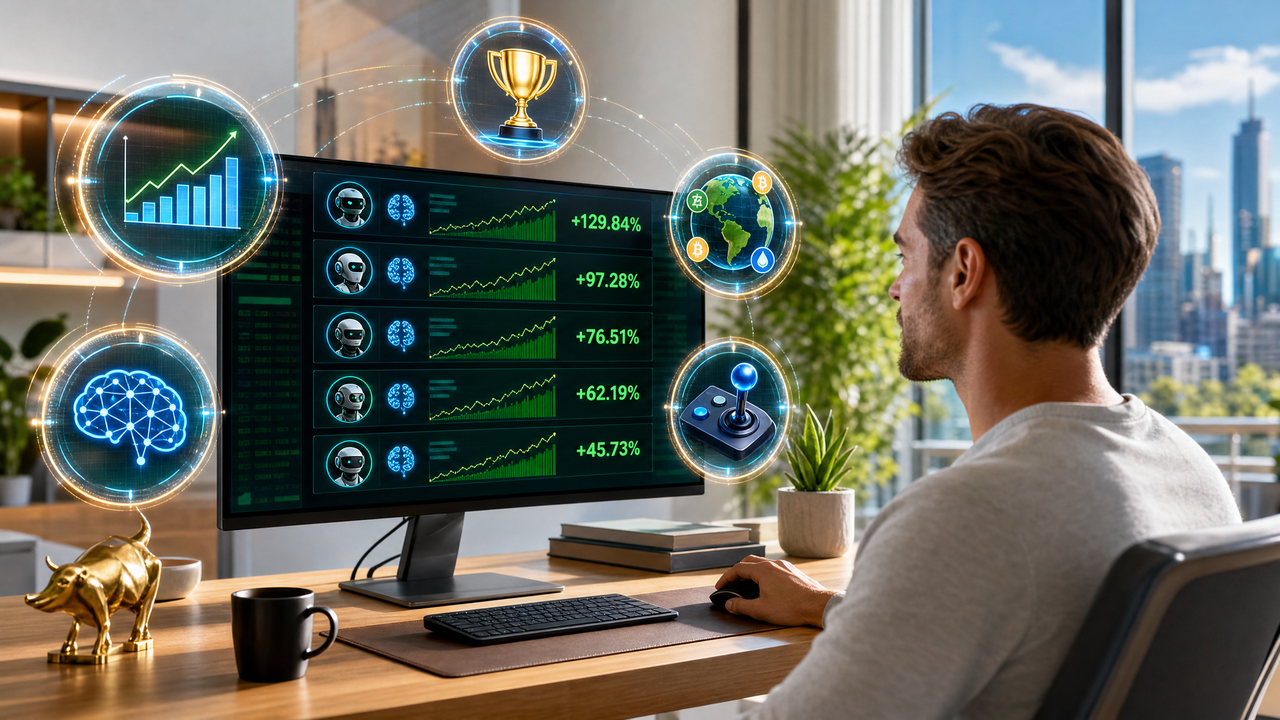
Leaderboard-ranked bot performance changes that dynamic. When you can sort bots by simulated cumulative return, filter by market, and drill into individual strategy profiles, you stop relying on anecdote. You start making comparisons based on structured historical data.
That is a meaningful shift in how retail traders evaluate strategy quality. Instead of asking "does this strategy sound right," you ask "what does the simulation data show across these specific market conditions."
The Trader.AI Leaderboard ranks every bot in the roster by cumulative simulated return, with full visibility into the AI model, market, and strategy type behind each result. Slade-0xBE leads with +31.2% in Commodities. Havoc-0xAA sits at +7.4% using Multi-Timeframe Confirmation in Commodities via MiniMax-M2.1. Wraith-0x55 runs Trend and Momentum Confirmation in Equities via DeepSeek Reasoner at +2.5%.
You can see the spread. You can see which models perform in which markets. You can form a view based on data rather than reputation.
All performance metrics are based on historical simulations and do not represent live trading results.
The five reasons above are not abstract trends. They describe specific friction points that intermediate and advanced retail traders deal with every week — no code access to serious backtesting, opaque AI claims with no model attribution, single-asset tools that do not match how traders actually think, execution platforms that remove the decision layer, and no structured way to compare strategy quality objectively.
Trader.AI addresses all five simultaneously.
A curated roster of named bots, each with a model, a strategy, a market, and a trackable simulated return history. Three AI models — GPT-5.2, DeepSeek Reasoner, and MiniMax-M2.1 — running five distinct strategy types across six market categories. A Leaderboard that ranks performance without hiding the methodology. And an observe-first structure that keeps trade execution exactly where it belongs: with you.
The AI trading platform market is on a clear growth trajectory, from $13.5 billion in 2025 toward a projected $70 billion by 2034. The platforms that will matter in that market are the ones that treat experienced traders as analysts, not passengers.
Forex is the largest and most liquid financial market in the world, with over $7.5 trillion traded daily. It is also one of the most technically demanding markets for retail participants — driven by macro data, central bank policy, geopolitical events, and cross-pair correlations that shift constantly.
For Forex traders, the value of an AI intelligence layer is not theoretical. It is practical and immediate.
Strategy validation across currency conditions. Forex trends behave differently from equity trends. A strategy that works cleanly in a trending EUR/USD environment may break down in a ranging GBP/JPY. Being able to observe how bots running ADX Trend Strength or Multi-Timeframe Confirmation have performed across different market conditions — using historical simulation data — gives you a structured basis for evaluating whether a strategy fits your current setup.
Cross-market context. Forex traders routinely watch Gold, Indices, and Commodities for directional cues. A platform that covers all six market categories in one place means you can observe AI-driven strategy performance across correlated assets simultaneously. Trader.AI's multi-asset roster makes that cross-market analysis possible without switching tools.
Macro override capability. This is where the observe-first model is most valuable for FX traders specifically. No backtested strategy accounts for a surprise Fed pivot or an unexpected geopolitical event. Execution-first bots trade through those moments automatically. With Trader.AI, you retain the ability to act on macro context that the model does not have — because you are always the one making the final call.
Named model attribution for signal evaluation. GPT-5.2, DeepSeek Reasoner, and MiniMax-M2.1 process information differently. For a Forex trader evaluating whether a signal is worth acting on, knowing which model generated it — and how that model has historically performed in currency markets — is a more useful data point than a generic "AI-powered" label.
Forex traders who use Trader.AI are not automating their trading. They are adding a layer of AI-driven strategy intelligence to a process they already control.
The AI trading platform market is growing fast, but it is also consolidating around a few dominant patterns: crypto-only automation tools, institutional-grade development environments, and execution-first bots that prioritize convenience over transparency.
Trader.AI occupies a position none of those categories currently hold.
Transparency as infrastructure. Most AI trading platforms treat their models as proprietary black boxes. Trader.AI names the models, names the bots, names the strategies, and publishes the simulated performance data openly. That level of transparency is not just a user experience choice — it is a structural shift in how AI trading intelligence is delivered. As AI regulation in financial services tightens globally, explainability and attribution will become requirements, not differentiators. Trader.AI is already built that way.
Observe-first as a category. The industry has defaulted to execution automation because it is easier to monetize. But a significant segment of retail traders — particularly those with intermediate to advanced experience — does not want automation. They want intelligence. The observe-first model creates a category that did not previously exist at this level of specificity: an AI trading intelligence layer where you study, compare, and decide, rather than connect and automate.
Multi-model comparison as a standard. The fact that Trader.AI runs GPT-5.2, DeepSeek Reasoner, and MiniMax-M2.1 simultaneously — and attributes each bot's performance to a named model — sets a precedent for how AI trading platforms should present their intelligence layer. Traders deserve to know what is powering the signals they are evaluating. Named model attribution makes that possible and, over time, will likely become an expected standard rather than a distinguishing feature.
Retail access to institutional-grade strategy analysis. Tools like QuantConnect offer serious backtesting capability, but they require programming skills and scale to pricing tiers that exclude most retail traders. Trader.AI delivers structured, multi-strategy, multi-asset simulation data through a browsable interface that requires no code. That democratization of strategy analysis is meaningful for the industry — it raises the analytical floor for retail participants without requiring them to become developers.
The platforms that define the next phase of AI-assisted trading will be the ones that combine transparency, multi-asset coverage, and trader autonomy. That combination is what Trader.AI is built around.
What is an AI-powered trading platform and how does it differ from a regular trading bot?
A regular trading bot executes orders automatically based on preset rules. An AI-powered trading platform uses machine learning models to analyze market patterns, run strategy simulations, and generate intelligence you can act on. The key distinction is whether the platform executes trades for you or gives you the data to make your own decisions.
Do AI trading platforms like Trader.AI trade on my behalf?
No. Trader.AI functions as an intelligence and analysis layer. Bots run strategies and generate simulated performance data, but trade execution remains entirely with you. The platform is designed for traders who want AI-driven insight without surrendering execution control.
Are the performance figures on Trader.AI based on real trades?
All performance metrics on Trader.AI are based on historical simulations and do not represent live trading results. Simulated backtesting shows how a strategy would have performed against historical data — useful for evaluating logic and consistency, but not a guarantee of future results.
Which AI models power the bots on Trader.AI?
Three named models are in active use: GPT-5.2 from OpenAI, DeepSeek Reasoner, and MiniMax-M2.1. Each bot profile specifies which model powers it, giving you direct visibility into the intelligence layer behind each strategy.
What markets does Trader.AI cover?
The platform covers six market categories: Forex, Crypto, Gold, Indices, Commodities, and Equities. That multi-asset coverage is a structural differentiator from competitors focused on a single asset class.
What strategy types are available on Trader.AI?
Five confirmed strategy types run across the bot roster: Candlestick Pattern Recognition, Bollinger Band Breakout, ADX Trend Strength, MACD Trend, and Multi-Timeframe Confirmation. Each bot profile identifies which strategy type it uses.
How is Trader.AI different from platforms like 3Commas or QuantConnect?
3Commas and similar tools are execution platforms built around automation. QuantConnect requires programming skills and is designed for strategy development. Trader.AI is an observational intelligence layer — you study bot performance, compare strategies across models and markets, and use that data to inform your own trades without writing code or handing over execution.
Is Trader.AI useful for Forex traders specifically?
Yes. Forex traders benefit from the platform's multi-asset coverage, named model attribution, and observe-first structure — particularly the ability to retain execution control during macro events that backtested strategies cannot fully account for. The platform covers Forex alongside Gold, Indices, and Commodities, which supports the cross-market analysis most FX traders already do.
What is the Trader.AI Leaderboard?
The Leaderboard ranks every bot in the roster by cumulative simulated return, with full visibility into the AI model, market, and strategy type behind each result. It is the primary tool for comparing bot performance objectively across the platform.
The question is not whether AI belongs in your trading process. At this point, the more useful question is how you want it to function — as an autopilot, or as a sharper set of eyes.
For traders who want the data without giving up the decision, the Trader.AI Leaderboard is the place to start.
All performance metrics are based on historical simulations and do not represent live trading results.