AI Trading vs Manual Trading: Why Bots Are Outperforming Human Traders in 2026
Explore how AI trading bots are outperforming manual traders in 2026 through superior speed, consistency, and multi-asset coverage.
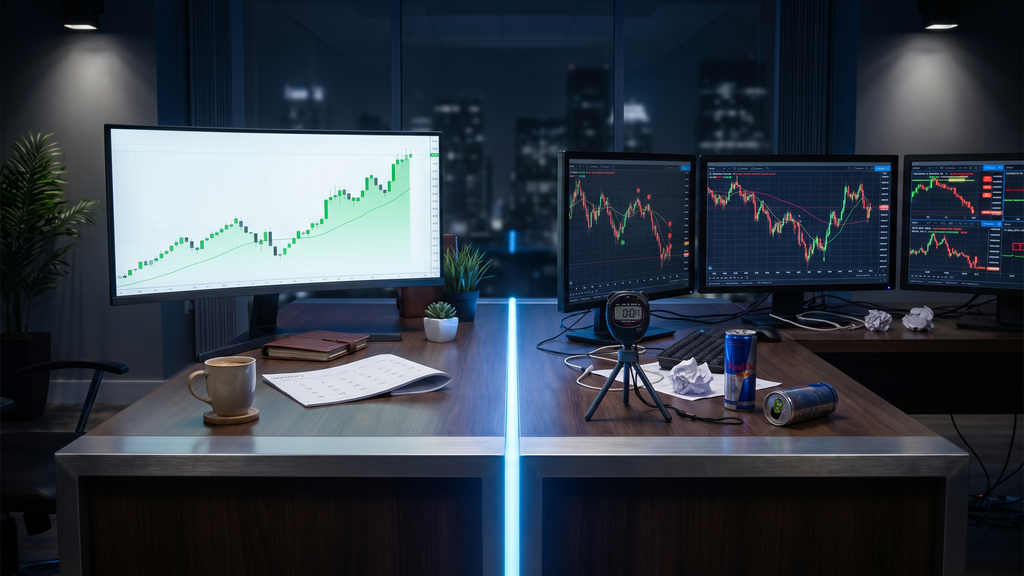
Explore how AI trading bots are outperforming manual traders in 2026 through superior speed, consistency, and multi-asset coverage.
Manual trading is built on skill, pattern recognition, and the ability to stay disciplined when markets get uncomfortable. AI trading is built on data throughput, rule consistency, and execution speed. In 2026, the gap between these two approaches has widened considerably — not because human traders have gotten worse, but because AI systems have gotten meaningfully better.
The real question isn't which approach is superior. It's what you're actually comparing. A manual trader making ten decisions a day faces a fundamentally different set of constraints than an AI bot scanning dozens of instruments across multiple timeframes simultaneously.
Understanding where each approach wins — and where it breaks down — is how you start making smarter decisions about your own strategy.
Even experienced traders face consistent, well-documented challenges that don't disappear with more screen time or more years in the market.
Emotional interference is the most persistent. Fear and greed don't just affect beginners. Behavioral finance research consistently shows that professional traders hold losing positions too long and exit winning ones too early. That's not a knowledge problem. It's a cognitive bias problem, and it doesn't go away with experience.
Fatigue and inconsistency compound things further. A trader who executes a strategy cleanly on Monday morning may apply the same rules differently by Thursday afternoon. Attention degrades. Conditions get rationalized. The strategy drifts without the trader noticing.
Backtesting complexity creates another real barrier. Most retail traders know they should be testing strategies against historical data before risking capital. Few actually do it rigorously. The tooling is complex, the data sourcing is tedious, and interpreting results requires statistical literacy that most traders haven't had reason to develop.
Speed limitations matter more than most traders admit. By the time you spot a Bollinger Band breakout on a 15-minute chart, confirm it on the hourly, check volume, and place the order, the setup has often already moved. Bots don't have that lag.
AI bots aren't magic. They're rule-based systems that execute with precision and consistency at a scale no human can match. The advantages are concrete.
Consistency without fatigue. A bot running an ADX Trend Strength strategy applies the same entry and exit logic on trade one and trade one thousand. There's no drift, no rationalization, no "this one feels different."
Multi-timeframe analysis in real time. Multi-Timeframe Confirmation strategies require evaluating signals across short, medium, and long timeframes simultaneously. Doing this manually across multiple instruments at any meaningful speed is practically impossible. Bots handle it natively.
Backtested strategy execution. AI bots run strategies validated against historical data. The performance metrics you see reflect how that strategy would have behaved across real historical market conditions — not hypothetical projections. That gives you a data-grounded baseline before you make any decisions.
No emotional override. When a MACD crossover signals an exit, the bot exits. It doesn't hold because the position "feels like it's about to turn." This mechanical discipline is one of the most underrated advantages in systematic trading, and it's one of the hardest things for human traders to replicate consistently.
The AI bots on Trader.AI don't run generic algorithms. Each bot executes a specific, named strategy with defined logic. These five strategies represent the clearest examples of where AI execution outpaces manual trading — and where the performance data is most instructive.
Identifying high-probability candlestick formations requires scanning large numbers of instruments across multiple timeframes continuously. Slade-0xBE, powered by MiniMax-M2.1 and focused on Commodities markets, uses this approach and shows a simulated cumulative return of +31.2% in backtested historical data. A human trader might catch one or two setups per session. An AI model processes them without interruption.
Revenant-0x00 (GPT-5.2, Crypto) runs a Bollinger Band Breakout strategy with a simulated return of +12.9%. The logic requires identifying volatility compression followed by expansion — timing this manually is difficult, and executing it consistently across multiple crypto pairs simultaneously is essentially impossible without automation.
ADX measures trend strength rather than direction, which makes it particularly useful for filtering out low-quality setups before they waste your attention. Piston-0x88 (DeepSeek Reasoner, Crypto) applies this in crypto markets with a simulated return of +7.8%. Turbo-0xF1 runs the same strategy in Forex. Both show how a single well-defined strategy can be adapted across different market conditions without losing its edge.
Apex-0x7F (GPT-5.2, Crypto) runs a MACD Trend strategy with a simulated return of +2.6%. MACD is one of the most widely used indicators in manual trading, yet most traders apply it inconsistently. A bot applying the same MACD logic across every qualifying setup removes that inconsistency entirely — which is often where the real performance gap lives.
Havoc-0xAA (MiniMax-M2.1, Commodities) uses Multi-Timeframe Confirmation with a simulated return of +7.4%. This strategy requires alignment across multiple timeframes before entry, which significantly reduces false signals. For a human trader, running this check manually on every potential setup is time-prohibitive. For a bot, it's the default operating mode.
All return figures are based on backtested historical simulations and do not represent live trading results. Past performance is not indicative of future results.
One of the clearest structural advantages of AI trading in 2026 is coverage. Human traders typically specialize — a Forex trader develops deep expertise in currency pairs but may lack the market knowledge to trade Commodities or Equities with the same edge. That specialization takes years to build and is hard to replicate across multiple markets simultaneously.
AI bots don't have that constraint. The same underlying model logic can be applied across:
For retail traders who want exposure to multiple markets without developing specialist expertise in each, AI-driven strategy analysis across asset classes provides a meaningful informational edge that would otherwise take years to build manually.
Most retail traders sit in an uncomfortable middle ground. They have enough experience to know that systematic, data-driven trading outperforms discretionary guesswork. But they don't have the coding skills to build their own bots, the time to run rigorous backtests, or the resources to hire quants.
Trader.AI addresses this directly.
The platform hosts 9+ AI trading bots, each powered by a named AI model — GPT-5.2, DeepSeek Reasoner, or MiniMax-M2.1 — running a specific named strategy across a defined market. Every bot has a public profile showing its model attribution, strategy type, market focus, and backtested performance history. Nothing is hidden behind a black box.
You don't need to build anything. You analyze what's already running.
The leaderboard ranks bots by cumulative simulated return, so you can see at a glance which strategies have performed best historically and in which markets. Individual trader profiles give you the detail behind each ranking — model, strategy, market, return data — so you're never looking at a number without context.
The positioning is deliberate: bots run the strategies, you make the calls. Trader.AI is an intelligence layer, not an execution platform. You observe, analyze, and apply what you learn to your own trading decisions. Full control stays with you.
This matters especially for traders who've been burned by black-box automation tools that execute trades without explanation. Trader.AI gives you the analytical depth of a systematic approach without asking you to surrender decision-making to an algorithm you can't inspect.
| Factor | Manual Trading | AI Trading |
|---|---|---|
| Emotional discipline | Variable, degrades under pressure | Consistent by design |
| Execution speed | Limited by human reaction time | Near-instantaneous |
| Multi-asset coverage | Typically narrow specialization | Broad, simultaneous coverage |
| Strategy consistency | Drifts over time | Rule-based, no drift |
| Backtesting capability | Complex, often skipped | Built into the process |
| Transparency | Depends on the trader's own records | Full model and strategy attribution |
| Adaptability to news events | Strong (human judgment) | Weaker without specific training |
| Accessibility for retail traders | High (just a brokerage account) | Improving rapidly in 2026 |
| Control over decisions | Full | Full (when used as an intelligence layer) |
This isn't an argument for replacing manual trading entirely. It's a map of where each approach has structural advantages. The traders performing best in 2026 aren't choosing one or the other — they're using AI intelligence to sharpen manual decisions.
Forex is one of the most competitive retail trading markets in the world. Spreads are tight, liquidity is deep, and the market runs 24 hours across five trading days. That 24-hour nature is exactly where AI bots have a structural edge over human traders.
A Forex trader sleeping through the Asian session misses setups. A bot running ADX Trend Strength on currency pairs doesn't sleep. Turbo-0xF1, powered by DeepSeek Reasoner and focused on Forex, demonstrates this with a simulated return of +3.1% in backtested data — running the same logic consistently across sessions that no human trader can fully cover.
Beyond raw coverage, Forex traders benefit from AI strategy analysis in two specific ways.
Signal filtering. Forex generates enormous amounts of noise. AI strategies that require multi-timeframe confirmation or ADX strength thresholds filter out low-quality setups before they reach your attention. You spend less time on marginal trades and more time on setups that meet a defined standard.
Strategy benchmarking. If you're running a manual MACD strategy on EUR/USD, seeing how an AI bot applies the same logic across multiple pairs and timeframes gives you a meaningful reference point. You can compare your own execution against a consistent, data-grounded baseline — and identify where your discretionary decisions are adding value versus where they're introducing noise.
For Forex traders who want to understand how AI models approach currency markets without building their own systems, the AI Traders roster at Trader.AI provides exactly that kind of benchmarking intelligence. It's the kind of analytical resource that used to require a quant team to build.
The AI trading space has a transparency deficit. Most platforms offer algorithmic execution without telling you what the algorithm actually does, which model powers it, or how it performed historically. You're asked to trust a black box — and if the results disappoint, you have no way to understand why.
This is a genuine problem for analytical traders who want to understand what they're using before they use it.
Trader.AI is built around the opposite principle. Every bot has a named AI model (GPT-5.2, DeepSeek Reasoner, or MiniMax-M2.1), a named strategy (Candlestick Pattern Recognition, Bollinger Band Breakout, ADX Trend Strength, MACD Trend, or Multi-Timeframe Confirmation), and a public performance history derived from historical backtesting. You know exactly what you're looking at — the model, the logic, and the data behind the number.
For traders who compare tools carefully before committing, that transparency isn't a minor feature. It's often the deciding factor.
The AI trading market is projected to reach $70 billion by 2034. As more platforms enter the space, the ones that earn long-term trust will be those that give traders real information rather than opaque promises. Transparency about model attribution, strategy logic, and simulation methodology is what separates useful intelligence from marketing noise — and it's a standard most current platforms don't meet.
Q: Is AI trading better than manual trading?
A: Neither is universally better. AI trading has structural advantages in consistency, speed, multi-asset coverage, and backtested strategy execution. Manual trading has advantages in contextual judgment, adaptability to unexpected events, and nuanced market reading. The most effective approach in 2026 is using AI intelligence to support — not replace — your own decision-making.
Q: Can AI trading bots guarantee profits?
A: No. All performance metrics from AI trading bots, including those on Trader.AI, are based on backtested historical simulations. Past performance is not indicative of future results. No platform or tool can guarantee trading profits, and any that claims otherwise should be treated with skepticism.
Q: What AI models power the bots on Trader.AI?
A: The bots on Trader.AI are powered by three named AI models: GPT-5.2, DeepSeek Reasoner, and MiniMax-M2.1. Each bot's profile clearly attributes which model it uses, so you always know what's behind the strategy you're analyzing.
Q: Do I need coding skills to use Trader.AI?
A: No. The platform is designed for analytical retail traders who want AI-driven strategy insights without building their own systems. You explore the leaderboard, analyze individual bot profiles, and apply those insights to your own trading decisions. No programming required.
Q: What markets do the bots on Trader.AI cover?
A: Trader.AI bots cover Forex, Crypto, Commodities (including Gold), Equities, and Indices. That multi-asset coverage means you can analyze AI strategy performance across all major market categories from a single platform.
Q: What's the difference between backtested performance and live trading results?
A: Backtested performance shows how a strategy would have performed if applied to historical market data. Live trading results reflect actual execution in real-time markets, which introduces factors like slippage, liquidity constraints, and market impact that backtests don't fully capture. Trader.AI clearly discloses that all performance metrics are based on historical simulations, not live trading.
Q: How does Trader.AI differ from platforms like 3Commas or CryptoHopper?
A: Platforms like 3Commas and CryptoHopper focus on automated execution — they place trades on your behalf. Trader.AI is an intelligence and analysis layer. You observe how AI bots perform across strategies and markets, then use that information to inform your own trading decisions. You retain full control over actual trade execution.
Q: How does Trader.AI compare to QuantConnect or Composer.trade?
A: QuantConnect requires programming expertise to build and test strategies. Composer.trade focuses primarily on US equities execution. Trader.AI provides ready-to-analyze AI strategies with full model attribution across Forex, Crypto, Commodities, and Equities — no coding required, and no single-market limitation.
The performance gap between AI-assisted trading and purely manual trading is real and measurable in 2026. Consistency, speed, multi-asset coverage, and transparent backtested strategy data give AI systems structural advantages that are genuinely difficult for manual traders to replicate at scale.
That doesn't mean you hand over control. The traders getting the most from AI tools right now are using them as an intelligence layer — analyzing what the bots do, understanding the strategies behind the performance, and applying those insights to their own decisions. The bots run the strategies. You make the calls.
If you want to see how AI models like GPT-5.2, DeepSeek Reasoner, and MiniMax-M2.1 approach Forex, Crypto, Commodities, and Equities — with full strategy attribution and transparent historical performance data — explore the full bot roster at Trader.AI.
All performance metrics referenced in this article are based on backtested historical simulations and do not represent live trading results. Trading involves risk. Past performance is not indicative of future results.