CFD vs Futures Trading: Key Differences Every Trader Should Know
Explore the key differences between CFD and futures trading, covering costs, leverage, and accessibility to help you choose the right instrument.

Explore the key differences between CFD and futures trading, covering costs, leverage, and accessibility to help you choose the right instrument.
#cfd-vs-futures-trading-key-differences-every-trader-should-know-2026
The debate between CFD and futures trading splits the trading community. Futures traders often dismiss CFDs as "fake derivatives for retail amateurs." CFD traders counter that futures are "overpriced relics with unnecessary complexity." Both sides miss the point.
Your choice between CFDs and futures shouldn't be about trading superiority. It should be about which instrument matches your capital, strategy, and execution needs. This breakdown covers structure, costs, leverage, and accessibility — so you can decide based on data, not opinions.
A CFD is an agreement between you and your broker to exchange the price difference of an underlying asset from open to close. You never own the asset — just the price movement. When you buy a CFD on Apple stock at $180 and sell at $185, you pocket the $5 difference per share. If the price drops to $175, you lose $5 per share.
CFDs track stocks, indices, commodities, forex, and cryptocurrencies. Your broker provides the counterparty and typically sources pricing from multiple liquidity providers. Most CFD brokers operate on MetaTrader 4 or 5 platforms with spreads starting from 0.0 pips on major pairs.
A futures contract obligates you to buy or sell a specific quantity of an asset at a predetermined price on a set expiration date. Unlike CFDs, futures trade on centralized exchanges like CME, ICE, or Eurex. Each contract has standardized specifications — size, expiration, tick value, and margin requirements.
For example, one E-mini S&P 500 futures contract (ES) represents $50 times the index value. At 4,200 points, one contract controls $210,000 worth of exposure. Futures require exchange membership or broker access, with commissions typically ranging from $0.85 to $4.95 per side.
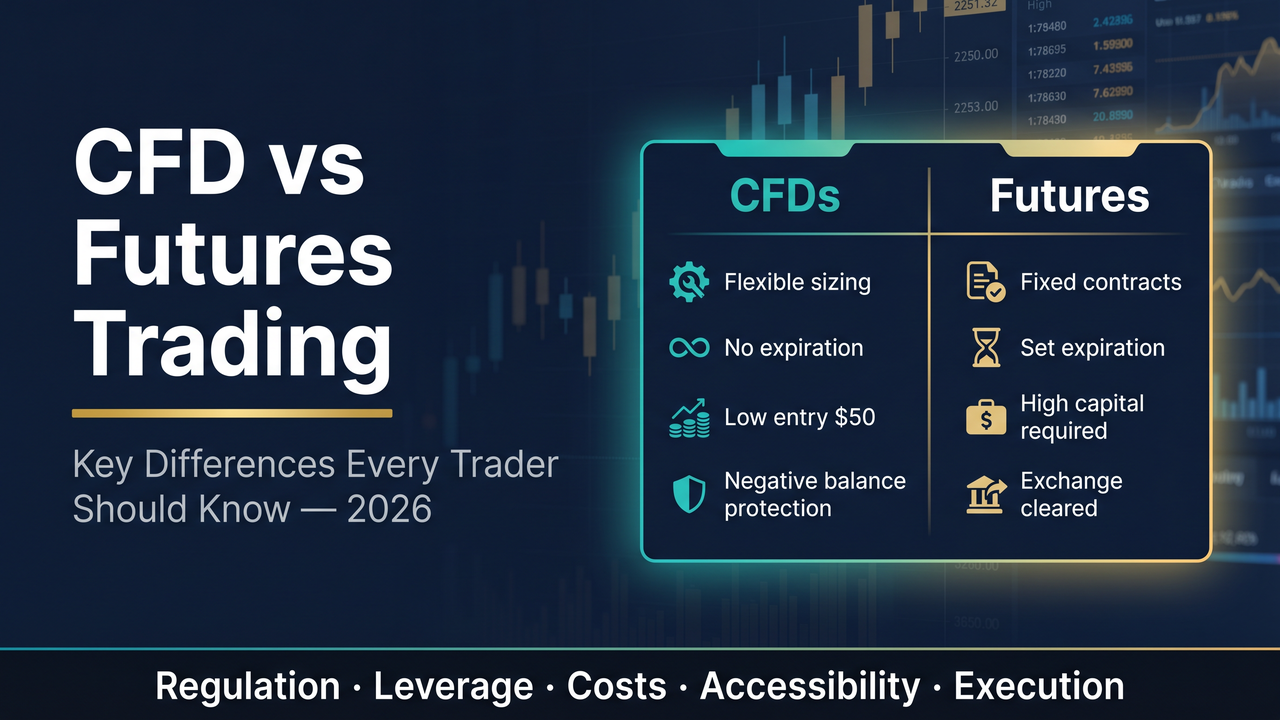
CFDs offer flexible position sizing. You can trade 0.01 lots on EUR/USD or buy 17 shares of Tesla CFDs. Position size adapts to your account and risk tolerance.
Futures use fixed contract sizes. One crude oil futures contract represents 1,000 barrels. One gold futures contract covers 100 troy ounces. You cannot trade partial contracts — it's all or nothing.
CFDs have no expiration date. You can hold a position for days, weeks, or months. Your broker charges overnight financing (swap rates) for leveraged positions held past market close.
Futures expire on specific dates. Most contracts expire monthly or quarterly. To maintain exposure beyond expiration, you must roll your position to the next contract month — often at a different price.
CFD trading involves your broker as counterparty. When you buy EUR/USD CFDs, you're essentially betting against your broker's pricing. Reputable brokers hedge client positions with liquidity providers, but the relationship remains bilateral.
Futures trading uses central clearing. The exchange clearinghouse becomes counterparty to every trade, eliminating counterparty risk between individual traders. If your counterparty defaults, the clearinghouse guarantees settlement.
CFD brokers profit through spreads, commissions, or both:
At Spec Markets, Raw Zero accounts offer spreads from 0.0 pips with $3.50 commission per lot. Pure Spread accounts start at 1.0 pip spreads with no commission. Both require just $50 minimum deposit.
Futures trading involves multiple fee layers:
Total round-trip costs range from $2.50 to $15 per contract, depending on your broker and exchange. High-frequency traders often negotiate volume discounts.
CFD Route: Trade 1 lot of SPX500 CFD (equivalent to $50 per point)
Futures Route: Trade 1 E-mini S&P 500 contract (ES)
Futures win on direct costs, but CFDs offer lower capital requirements and position flexibility.
CFD brokers offer leverage up to 1000:1 on major forex pairs, though regulatory limits vary by jurisdiction. Leverage on indices typically ranges from 20:1 to 100:1. Stock CFDs usually offer 5:1 to 20:1 leverage.
Example: With 100:1 leverage, you control $100,000 EUR/USD exposure with $1,000 margin. Your broker provides the remaining $99,000.
Most CFD brokers include negative balance protection, ensuring you cannot lose more than your account balance. This zero cut system protects retail traders from margin calls exceeding their deposits.
Futures margin requirements are set by exchanges and vary by contract and volatility. Initial margin covers the minimum deposit to open a position. Maintenance margin triggers margin calls if your account falls below the threshold.
Example: E-mini S&P 500 futures require approximately $13,200 initial margin per contract (as of 2026). This controls roughly $210,000 in market exposure — equivalent to 16:1 leverage.
Unlike CFDs, futures trading can result in losses exceeding your account balance. Margin calls demand immediate deposits or forced liquidation.
CFD brokers cater to retail traders with low barriers to entry:
Futures trading requires higher capital and experience thresholds:
CFD regulation varies significantly by jurisdiction. European regulators impose strict leverage limits (30:1 on major pairs) and negative balance protection requirements. Offshore jurisdictions offer higher leverage but less regulatory oversight.
Reputable CFD brokers maintain segregated client accounts at tier-1 banks and carry professional indemnity insurance. Always verify your broker's regulatory status before depositing funds.
Futures markets operate under strict regulatory oversight. In the US, the CFTC regulates futures exchanges and brokers. Similar bodies govern futures trading in other major jurisdictions.
Exchange clearing and daily mark-to-market requirements provide additional safety layers. However, regulatory protection doesn't eliminate trading losses or guarantee broker solvency.
CFDs excel for retail day traders and swing traders who prioritize accessibility and position flexibility over absolute cost efficiency.
Futures suit institutional traders and well-capitalized retail traders who prioritize execution quality and regulatory transparency over accessibility.
The "CFDs vs futures superiority" argument misses the fundamental point. Neither instrument is inherently better — they serve different trader profiles and capital levels.
CFDs democratize access to global markets with institutional-grade execution. Spreads from 0.0 pips and $50 minimum deposits let skilled traders compete regardless of account size. The zero cut system protects against catastrophic losses that can wipe out futures accounts.
Futures provide the deepest liquidity and tightest spreads for traders with sufficient capital. Exchange clearing eliminates counterparty risk, and standardized contracts ensure transparent pricing. But high barriers to entry exclude most retail traders.
Your choice should align with your capital, experience, and trading objectives — not tribal loyalty to one instrument over another.
CFD trading doesn't require sacrificing execution quality for accessibility. At Spec Markets, your trades execute in 0.028 seconds with spreads from 0.0 pips on major pairs. Choose Raw Zero accounts for transparent commission pricing or Pure Spread accounts for simplified cost structure.
Both account types offer leverage up to 1000:1, negative balance protection, and access to forex, indices, commodities, metals, and cryptocurrencies. Start with just $50 and scale your positions as your account grows.
Start Trading with institutional-grade conditions designed for serious retail traders.
Risk Disclaimer: CFDs are complex instruments and come with a high risk of losing money rapidly due to leverage. You should consider whether you understand how CFDs work and whether you can afford to take the high risk of losing your money. Past performance is not indicative of future results.