What Is an Economic Cost? A Forex Trader's Guide to Opportunity Cost in 2026
Learn how to calculate economic and opportunity costs in forex trading to improve your profitability and decision-making in 2026.
Learn how to calculate economic and opportunity costs in forex trading to improve your profitability and decision-making in 2026.
Every trade you place carries two costs. One shows up on your statement. The other never does — but it shapes your profitability just as much.
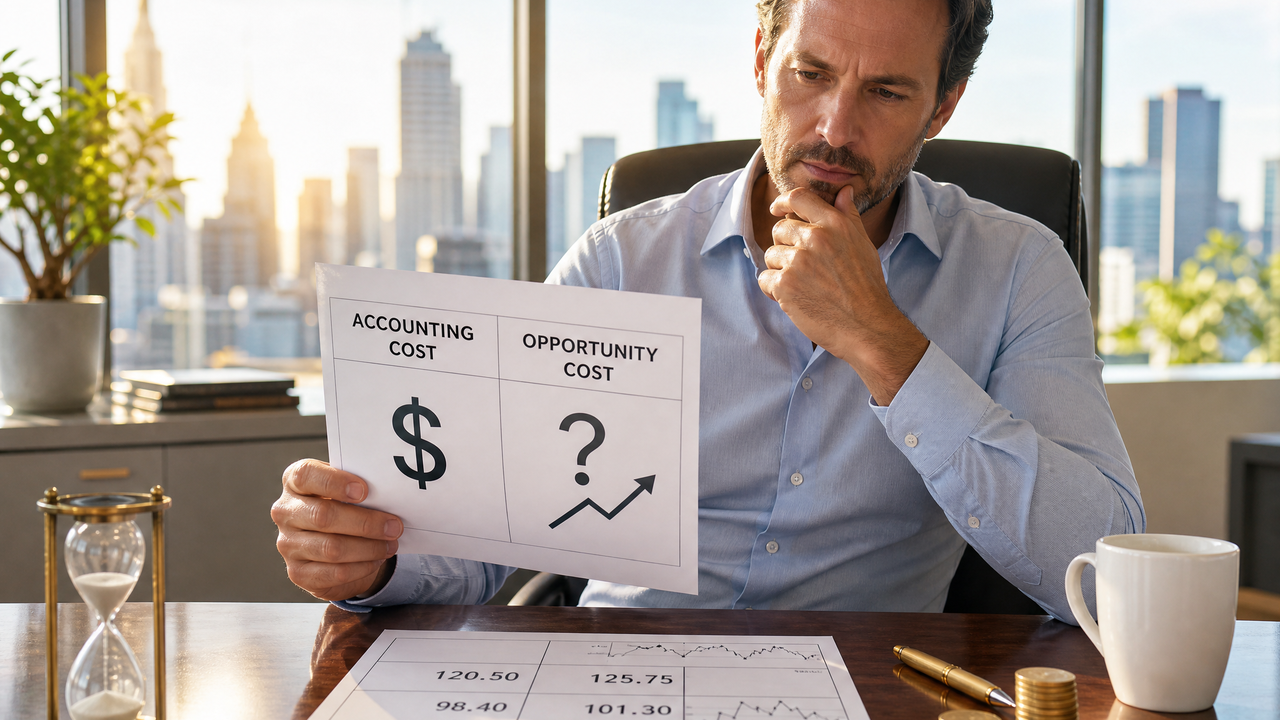
Economic cost is the total cost of a decision: the money you actually spend, plus the value of the best alternative you walked away from. That second part is opportunity cost, and for active forex traders, ignoring it is one of the most expensive habits in the market.
This guide breaks down what economic cost means, why opportunity cost matters to every trading decision you make in 2026, and how to start accounting for it properly.
Most traders track accounting costs without thinking twice. Spread paid, commission charged, swap rate debited — these are explicit, visible, and easy to measure.
Economic cost goes further. It adds the implicit cost of what you gave up by making that choice.
Accounting cost = what you paid directly
Economic cost = what you paid directly + the value of your best alternative foregone
Here's a simple example. You deposit $500 into a trading account and leave it idle for two weeks while you wait for a setup. The accounting cost is zero — you paid nothing. But the economic cost includes the trades you could have taken, the interest you could have earned, or the position you could have sized up on a different instrument. That foregone value is real, even if it never appears on a balance sheet.
Opportunity cost isn't abstract. It appears in specific, recurring decisions every active trader faces.
Say you trade 20 lots per week. On a Raw Zero account with spreads from 0.0 pips and a $3.50 commission per lot per side, your total commission on 20 lots is $140. On a Pure Spread account with spreads from 1.0 pips and no commission, your cost depends on the spread you actually trade at.
If your instruments average 1.2 pips and you're trading standard lots on EUR/USD — where each pip is worth $10 — your spread cost on 20 lots comes to $240. In that scenario, choosing Pure Spread over Raw Zero costs you an extra $100 per week in friction, even though both accounts look comparable at first glance.
The right choice depends on your style and volume. The point is that the decision carries an economic cost either way, and you need to calculate it before you open positions.
Every hour you hold an open position, you're implicitly passing on every other setup available in the market. If your EUR/USD trade sits flat for six hours while GBP/JPY trends 80 pips in one direction, the opportunity cost of that idle capital is real. You didn't lose money on paper — but your economic cost includes the profit you didn't capture.
This hits hardest for scalpers and day traders with limited margin who need to allocate capital efficiently across sessions.
Execution speed is a direct economic cost most traders underestimate. A broker averaging 0.5-second execution versus one averaging 0.028 seconds doesn't just feel slower — in fast markets, that gap means the price you get isn't the price you intended. Slippage is an economic cost. Requotes are an economic cost. Every pip of slippage is a pip of foregone profit.
Keeping capital in a non-trading account while you research or hesitate carries an opportunity cost equal to whatever your active strategy would have returned during that period. That doesn't mean you should always be in the market — risk management matters. But the decision to stay out is still a decision, and it has an economic cost attached.
The formula is straightforward:
Opportunity cost = Return on best alternative foregone − Return on chosen option
If your chosen trade returns 1.5% and the setup you passed on returned 3.2%, your opportunity cost is 1.7%. You made money — but you left more on the table by taking the lower-return path.
In practice, you don't need exact precision. You need the habit of asking: what am I giving up by making this choice?
Apply that question to:
Each of these decisions has a best alternative. The gap between your choice and that alternative is your opportunity cost.
Broker selection is one of the highest-stakes economic cost decisions a trader makes — and most traders make it once and never revisit it.
Explicit costs are easy to compare: spreads, commissions, swap rates, minimum deposits. The implicit costs are harder to see but often larger:
At Spec Markets, the two-account structure is built to make this cost calculation simple. Raw Zero gives you spreads from 0.0 pips with a $3.50 commission per lot per side. Pure Spread gives you spreads from 1.0 pips with no commission. You pick the model that fits your volume and style — no guessing which of six account tiers applies to you.
Opportunity cost thinking sharpens risk management in one specific way: it forces you to weigh the cost of protecting capital against the cost of deploying it.
Holding cash isn't free. Neither is over-leveraging. The economic cost of a blown account isn't just the capital lost — it's every future trade you can't take while you rebuild. That's why negative balance protection matters. The zero cut system at Spec Markets ensures a losing trade can't push your account below zero, which caps the worst-case economic cost of a bad position.
The same logic applies to position sizing. Using 1000:1 leverage responsibly means sizing positions so the economic cost of being wrong stays within a range you can absorb and recover from. Without that discipline, maximum leverage turns opportunity cost into a catastrophic loss.
CFD trading involves significant risk of loss. Leverage amplifies both gains and losses, and you should only trade with capital you can afford to lose.
Here's a practical framework for building opportunity cost awareness into your trading process:
Before entering a trade — ask what else you could do with this margin. Is this the best available setup right now, or are you trading out of habit?
When choosing your account type — calculate your expected weekly lot volume and compare the total cost under Raw Zero versus Pure Spread at your typical spread levels. Use a margin and profit calculator to make it concrete.
When reviewing a losing week — separate accounting losses from economic losses. Did you lose because your setups were wrong, or because you chose the wrong setups when better ones were available?
When evaluating your broker — add up the implicit costs: slippage frequency, downtime incidents, time spent navigating a complex account structure. These are real costs even if they never appear on your statement.
When sitting out the market — be deliberate. Sitting out is a valid choice. But name the opportunity cost explicitly so you're making the decision consciously, not by default.
What does "economic cost can best be defined as" mean in simple terms?
Economic cost is the total cost of a decision — the direct money you spend (explicit cost) plus the value of the best alternative you gave up (opportunity cost). It's broader than accounting cost, which only captures what you actually paid.
How is opportunity cost different from a trading loss?
A trading loss is a direct, measurable reduction in your account balance. Opportunity cost is the profit you didn't earn because you chose one path over another. You can have zero accounting losses in a week and still carry a high opportunity cost if better setups were available and you missed them.
Does account type choice affect economic cost for forex traders?
Yes, significantly. A high-volume scalper typically benefits from raw spreads plus commission, while a lower-frequency swing trader may find an all-in spread more cost-efficient. Calculating the total cost under each structure before you commit is a direct application of economic cost thinking.
Why does execution speed matter for economic cost?
Slower execution increases the probability of slippage — the gap between the price you intended and the price you got. Slippage is an implicit cost that compounds across hundreds of trades. Faster, more reliable execution reduces that drag.
What is the opportunity cost of trading with an unregulated broker?
Beyond the spread and commission you pay, an unregulated broker carries the implicit cost of counterparty risk. If the broker becomes insolvent or acts dishonestly, your deposited capital may not be recoverable. That risk has a real economic value — one that regulated brokers eliminate.
How does leverage affect opportunity cost calculations?
Higher leverage lets you control larger positions with less capital, which means your capital can theoretically be deployed across more opportunities at once. But it also raises the economic cost of a loss, since a leveraged loss can wipe out capital that would otherwise fund future trades. Responsible leverage use means factoring this into every position sizing decision.
Can economic cost thinking improve trading performance?
It can improve decision quality, which is the foundation of performance. Traders who consistently ask "what am I giving up by making this choice?" tend to be more deliberate about setups, account structure, broker selection, and risk management. That discipline doesn't guarantee profits, but it reduces the hidden friction that erodes returns over time.
Economic cost thinking isn't complicated. It's the habit of seeing the full cost of a decision — not just the line item on your statement.
For forex traders in 2026, that means accounting for slippage, execution quality, account structure, broker reliability, and the setups you pass on — not just the spread you pay. Traders who do this consistently make better decisions with their capital, their time, and their risk.
If you want a broker where the explicit costs are transparent and the implicit costs are minimized, review the account options and execution conditions at Spec Markets and open a live account or try a free demo.
Trading CFDs involves significant risk of loss. Leverage can work against you as well as for you. Ensure you understand the risks involved before trading.