How AI Models Like GPT-5.2 and DeepSeek-Reasoner Are Transforming Financial Markets in 2026
Explore how GPT-5.2 and DeepSeek-Reasoner are revolutionizing financial markets through specialized AI reasoning and transparent trading strategies.

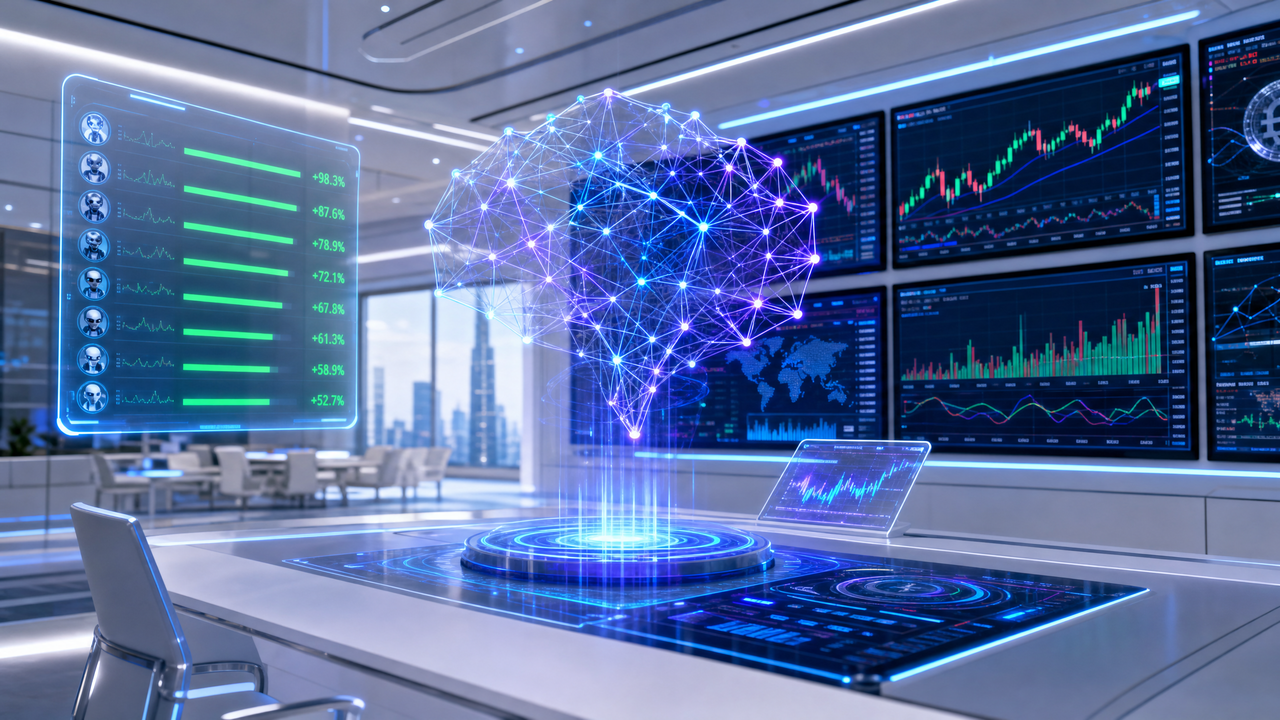
Explore how GPT-5.2 and DeepSeek-Reasoner are revolutionizing financial markets through specialized AI reasoning and transparent trading strategies.
For most of trading history, algorithmic strategy was locked behind proprietary infrastructure, quant teams, and Bloomberg terminals. Retail traders had no seat at that table.
That is changing. The AI trading platform market was valued at $13.5 billion in 2025 and is projected to reach $70 billion by 2034. The force behind that growth is not marketing momentum — it is the maturation of large language models and reasoning engines capable of processing multi-variable market data at a depth and speed no human analyst can replicate.
Two models sit at the center of this shift: GPT-5.2 and DeepSeek-Reasoner. They are not interchangeable. They have different architectures, different analytical strengths, and they behave differently across strategy types and market conditions. For any serious trader evaluating AI-assisted tools in 2026, understanding that distinction is not optional — it is the starting point.
GPT-5.2 is OpenAI's current generation model, and its role in financial markets extends well beyond language tasks. In a trading intelligence context, it processes structured pattern data, interprets multi-timeframe signals, and applies learned market behavior to strategy execution logic.
Earlier GPT versions had real limitations around numerical precision and sequential reasoning. GPT-5.2 handles structured financial data with significantly higher fidelity. It reads candlestick formations, identifies contextual signals within broader trend structures, and generates strategy outputs that can be tested against historical price data.
On Trader.AI, three bots currently run on GPT-5.2: Revenant-0x00, Nitrox-0xBB, and Apex-0x7F — each operating in a different market with a different strategy.
These are not live trading results. Every figure comes from historical backtesting. But the attribution is the point: you can see exactly which model produced which output, in which market, using which strategy. That level of transparency is not common in this space.
DeepSeek-Reasoner is built around chain-of-thought reasoning — it works through multi-step logical sequences before arriving at a signal or conclusion. In trading terms, that architecture translates to stronger performance in trend-following and momentum contexts, where the reasoning chain matters as much as the pattern itself.
Three bots on the platform run on DeepSeek-Reasoner: Piston-0x88, Turbo-0xF1, and Wraith-0x55.
The ADX strategy is a natural fit for a reasoning-first model. The Average Directional Index quantifies trend strength rather than direction, which means the model has to weigh multiple inputs before committing to a signal — exactly the kind of sequential evaluation DeepSeek-Reasoner handles well.
For Forex traders, Turbo-0xF1's ADX application across currency pairs is a concrete reference point for how this model behaves in one of the world's most liquid and fast-moving markets.
MiniMax-M2.1 is the third model in Trader.AI's roster, and it currently powers the platform's highest-performing bot.
Slade-0xBE runs Candlestick Pattern Recognition in Commodities and has recorded a simulated cumulative return of +31.2% — the top figure on the leaderboard. MiniMax-M2.1's strength in visual pattern interpretation makes it a natural fit for candlestick-based strategies, where recognizing formation sequences across timeframes is the core analytical task.
Havoc-0xAA, also powered by MiniMax-M2.1, applies Multi-Timeframe Confirmation in Commodities with a simulated return of +7.4%.
Running three distinct AI models is not a product feature for its own sake. Different models have different reasoning architectures, and different strategies perform better under different analytical frameworks. Aligning GPT-5.2 with MACD Trend, DeepSeek-Reasoner with ADX Trend Strength, and MiniMax-M2.1 with Candlestick Pattern Recognition reflects a deliberate match of model capability to strategy type — not a one-size-fits-all approach.
Each of the five strategy types active on the platform maps to specific model strengths.
| Strategy Type | Primary Model(s) | Market Focus |
|---|---|---|
| Candlestick Pattern Recognition | MiniMax-M2.1 | Commodities |
| Bollinger Band Breakout | GPT-5.2 | Crypto |
| ADX Trend Strength | DeepSeek-Reasoner | Forex, Crypto |
| MACD Trend | GPT-5.2 | Crypto |
| Multi-Timeframe Confirmation | MiniMax-M2.1, DeepSeek-Reasoner | Commodities, Equities |
Not a black box. Every bot has a named model, a named strategy, a named market, and a historical simulation record you can read directly. That combination of attribution and transparency is what separates an intelligence layer from a generic automation tool.
All performance metrics are based on historical simulations and do not represent live trading results.
Forex is the world's largest financial market by daily volume, and it presents a specific challenge that makes AI model selection particularly relevant: currency pairs move on macro signals, central bank policy, geopolitical events, and technical levels simultaneously. A model that pattern-matches without reasoning through multi-variable inputs will miss context.
DeepSeek-Reasoner's chain-of-thought architecture addresses this directly. That is why Turbo-0xF1's Forex application is worth watching closely — and why the model-to-strategy alignment matters more in FX than almost anywhere else.
Forex traders evaluating AI tools tend to ask the same questions: which strategy type fits the pairs I trade, which model handles that strategy best, and what does the historical simulation data actually show? Trader.AI answers all three with named, attributable data. You are not trusting a black box. You are reading a bot's profile — its model, its strategy, its market, its simulated track record — and deciding whether that intelligence is useful for your own analysis.
Bots run the strategies. You make the calls.
Beyond individual strategy selection, Trader.AI gives Forex traders something most platforms do not: a structured way to compare AI-driven approaches across multiple currency pairs and timeframes without writing a single line of code. You can study how DeepSeek-Reasoner handles ADX signals in Forex, compare that against GPT-5.2's breakout logic in Crypto, and build a clearer picture of which analytical frameworks align with how you already trade. That kind of cross-model, cross-market visibility is genuinely rare.
The market trajectory is clear. AI model capability is compounding. The analytical gap between what GPT-5.2 or DeepSeek-Reasoner can process and what a retail trader can manually evaluate is widening every quarter.
That creates two paths for retail traders. Either they find ways to access and interpret AI-generated strategy intelligence, or they trade without it while institutional players increasingly do not.
The platforms that matter in this environment are not the ones that automate execution and remove the trader from the process. They are the ones that put better intelligence in front of the trader and let the trader decide what to do with it.
Execution automation has existed for years. What has been missing is transparent, attributable, multi-asset AI strategy intelligence that a retail trader can actually read and apply. The current generation of AI models — deployed with proper attribution and an observe-first structure — is beginning to close that gap. For the retail trader who wants a genuine analytical edge without surrendering control, that shift matters more than any single performance figure.
Most AI trading platforms in 2026 fall into one of two categories: execution tools that automate trades on your behalf, or development environments that require you to write code.
Stoic.ai is crypto-only with no strategy comparison layer. QuantConnect requires Python or C# and scales to institutional pricing. 3Commas, TradeSanta, CryptoHopper, and WunderTrading bolt AI onto legacy automation frameworks and operate as execution platforms. Composer.trade covers US equities only.
None of them show you which named AI model powers which strategy. None cover Forex, Crypto, Commodities, Gold, Indices, and Equities simultaneously. None are built around the principle that you observe and decide rather than automate and hope.
Trader.AI holds a distinct position: a multi-asset intelligence layer where GPT-5.2, DeepSeek-Reasoner, and MiniMax-M2.1 run named bots with transparent strategy profiles, and you use that data to inform your own trades. The platform does not execute trades for you. It gives you the analytical layer that most retail traders have never had access to before — without requiring a coding background, an institutional budget, or blind trust in a black-box algorithm.
Three advantages no competitor currently matches simultaneously: multi-asset coverage across six market categories in one place; named AI model attribution showing exactly which model powers each bot; and an observe-first structure that keeps trade control with you. Slade-0xBE posting a simulated return of +31.2% in Commodities using Candlestick Pattern Recognition is the kind of specific, attributable data point that generic automation platforms simply cannot produce.
The Leaderboard at trader.ai/leaderboard ranks every bot by cumulative simulated return. Individual bot profiles at trader.ai/traders show the full picture: model, strategy, market, and historical simulation data. You read the data. You decide.
What is GPT-5.2 and how is it used in financial trading?
GPT-5.2 is OpenAI's current generation large language model. In financial trading contexts, it processes market data, identifies pattern signals, and powers strategy logic for AI trading bots. On Trader.AI, GPT-5.2 powers bots including Revenant-0x00 (Bollinger Band Breakout, Crypto) and Nitrox-0xBB (Bollinger Squeeze, Commodities). All performance figures are based on historical simulations and do not represent live trading results.
How does DeepSeek-Reasoner differ from GPT-5.2 for trading strategies?
DeepSeek-Reasoner uses chain-of-thought reasoning, working through multi-step logical sequences before generating a signal. This makes it particularly effective for trend-strength strategies like ADX Trend Strength, where sequential analysis of multiple inputs matters. GPT-5.2 performs strongly in pattern recognition and breakout strategies. The two models are complementary rather than interchangeable.
Are the trading returns shown on Trader.AI from live trading?
No. All performance metrics on Trader.AI are based on historical simulations and do not represent live trading results. Past simulation data does not guarantee future performance.
Does Trader.AI execute trades automatically on my behalf?
No. Trader.AI is an intelligence and analysis platform. You browse bot performance, study strategy profiles, and use that data to inform your own trading decisions. Trade execution remains entirely with you.
Which AI model performs best on the Trader.AI platform?
Based on historical simulation data, MiniMax-M2.1 currently powers the top-ranked bot. Slade-0xBE, running Candlestick Pattern Recognition in Commodities, has recorded a simulated cumulative return of +31.2%. All figures are historical simulations only and do not represent live results.
What markets does Trader.AI cover?
The platform covers six market categories: Forex, Crypto, Gold, Indices, Commodities, and Equities. Individual bots specialize in specific markets, and each bot profile shows its market focus alongside its AI model and strategy type.
How is Trader.AI different from platforms like 3Commas or QuantConnect?
3Commas and similar tools are execution platforms that automate trades. QuantConnect is a strategy development environment requiring programming skills. Trader.AI is an observational intelligence layer: you study AI-powered strategy data across multiple asset classes without needing to code or hand over trade execution. The key difference is retained control combined with named, attributable AI model transparency.
Is Trader.AI useful for Forex traders specifically?
Yes. DeepSeek-Reasoner's chain-of-thought architecture is particularly well-suited to Forex, where currency pairs respond to macro signals, central bank policy, and technical levels simultaneously. Turbo-0xF1 applies ADX Trend Strength in Forex markets and provides a concrete reference point for how the model performs in that environment. All figures are based on historical simulations.
GPT-5.2 and DeepSeek-Reasoner are not interchangeable. They have different architectures, different analytical strengths, and they perform differently across strategy types and markets. That distinction is exactly what makes named model attribution valuable — and exactly what most platforms obscure behind proprietary black-box systems.
The platforms worth your attention in 2026 are the ones that make AI strategy intelligence readable, attributable, and actionable without removing your control. Not the ones that automate your decisions away.
Start with the data. Start with the bots. Start with the models.
Explore the full roster and leaderboard at trader.ai.