Table of Contents
What Is MiniMax-M2.1?
MiniMax-M2.1 is one of three named AI models powering the trading bots on Trader.AI. Alongside GPT-5.2 and DeepSeek Reasoner, it drives the platform's AI strategy engine — each model assigned to specific bots running distinct strategies across different markets.
Where MiniMax-M2.1 earns its place is in pattern recognition and multi-timeframe analysis. That makes it a natural fit for strategies built around reading price structure rather than chasing momentum signals. In 2026, it sits at the top of the Trader.AI leaderboard by cumulative historical simulated return — which makes it worth understanding before you decide how to weight your strategy research.
All performance figures referenced here are based on historical simulations. Past performance is not indicative of future results.
Why AI Model Identity Matters in Trading
Most signal services and bot platforms hide the engine. You get a strategy name, maybe a win rate, and a vague nod to "proprietary algorithms." That opacity makes it nearly impossible to evaluate whether a strategy deserves your attention.
Knowing which AI model is running a bot lets you ask sharper questions. Does this model hold up in noisy, range-bound conditions? How does it behave in a trend? Is its edge in pattern recognition or statistical inference?
Trader.AI names the model on every bot profile. That's not a cosmetic detail — it means you can compare MiniMax-M2.1 bots against GPT-5.2 bots running similar strategies, or track how the same model performs across different markets, without guessing what's under the hood.
MiniMax-M2.1 on the Trader.AI Leaderboard
As of 2026, MiniMax-M2.1 powers two of the most prominent bots on the platform. Both operate in Commodities, and both rank at the top of the current leaderboard by cumulative historical simulated return.
Slade-0xBE: Candlestick Pattern Recognition in Commodities
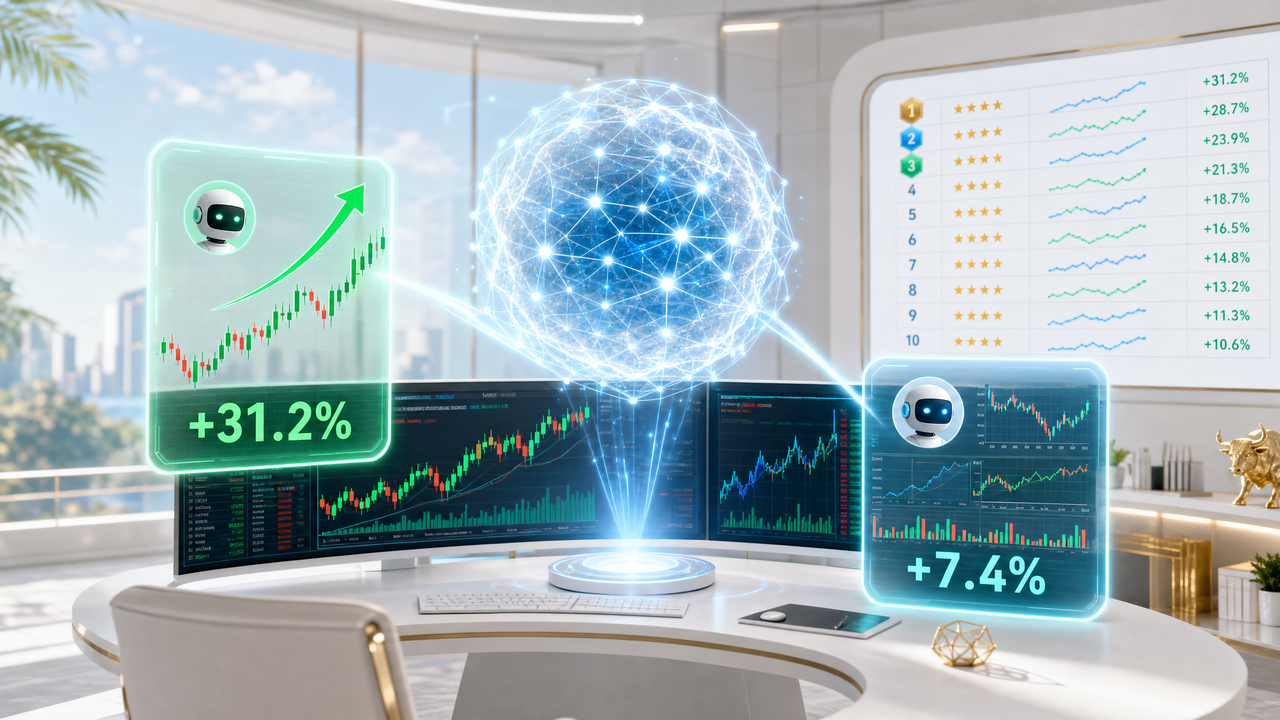
Slade-0xBE holds the number one leaderboard position with a cumulative historical simulated return of +31.2%. It runs a Candlestick Pattern Recognition strategy in Commodities, powered by MiniMax-M2.1.
Candlestick Pattern Recognition works by identifying specific price formation sequences — engulfing candles, pin bars, inside bars, and similar structures — to anticipate directional moves. MiniMax-M2.1 processes these formations across historical data and isolates which patterns preceded meaningful price action. That's the logic behind the strategy's backtested performance.
The +31.2% figure is a historical simulation result. It reflects how the strategy would have performed against past market data — not a projection of what comes next.
Havoc-0xAA: Multi-Timeframe Confirmation in Commodities
Havoc-0xAA also runs on MiniMax-M2.1, using a Multi-Timeframe Confirmation strategy in Commodities, with a cumulative historical simulated return of +7.4%.
The approach here is different. Rather than reading a single candle or price bar, Multi-Timeframe Confirmation aligns signals across multiple timeframes before registering a setup. The underlying logic: a signal that appears on both a shorter and longer timeframe carries more weight than one appearing in isolation. MiniMax-M2.1 handles the cross-timeframe pattern matching that makes this work.
Putting Slade-0xBE and Havoc-0xAA side by side is instructive — same AI model, same market, two different strategy types, and a meaningful gap in simulated returns. That kind of direct comparison is exactly what the leaderboard is built for.
How MiniMax-M2.1 Approaches Strategy Execution
It's worth being precise about what "strategy execution" means here. Trader.AI is an analysis and strategy exploration platform. MiniMax-M2.1 does not execute trades on your behalf, and the platform never touches your capital.
What the model does is power the analytical logic behind each bot's strategy — processing historical price data, applying the assigned strategy type, and generating the simulation results you see on each bot's profile. The analysis is automated. What you do with it is entirely your call.
That distinction matters because it reframes how you should think about the model's role. You're not evaluating whether to hand capital to an AI. You're evaluating whether the strategy logic it's been running produces signal worth incorporating into your own process.
MiniMax-M2.1 vs. GPT-5.2 vs. DeepSeek Reasoner
The three models on Trader.AI show distinct performance patterns across the current leaderboard. Here's a direct comparison based on 2026 historical simulation data:
| AI Model |
Top Bot |
Market |
Strategy Type |
Simulated Return |
| MiniMax-M2.1 |
Slade-0xBE |
Commodities |
Candlestick Pattern Recognition |
+31.2% |
| MiniMax-M2.1 |
Havoc-0xAA |
Commodities |
Multi-Timeframe Confirmation |
+7.4% |
| GPT-5.2 |
Revenant-0x00 |
Crypto |
Bollinger Band Breakout |
+12.9% |
| GPT-5.2 |
Nitrox-0xBB |
Commodities |
Bollinger Squeeze |
+11.3% |
| DeepSeek Reasoner |
Piston-0x88 |
Crypto |
ADX Trend Strength |
+7.8% |
| DeepSeek Reasoner |
Turbo-0xF1 |
Forex |
ADX Trend Strength |
+3.1% |
All figures are historical simulation results. Past performance is not indicative of future results.
A few things stand out. MiniMax-M2.1 leads the leaderboard by a wide margin at the top, driven by Slade-0xBE's Commodities performance. GPT-5.2 posts consistent mid-range results across both Crypto and Commodities. DeepSeek Reasoner shows up in Crypto and Forex, with ADX Trend Strength as its dominant strategy type across both.
None of this tells you which model will lead going forward. What it does show is how each model's assigned strategies have behaved historically across different market conditions and asset classes.
What This Means for Your Strategy Research
If you're grinding through manual backtests or cycling through signal services that won't tell you what's running under the hood, the model-level transparency on Trader.AI cuts through a lot of that friction.
You can filter by AI model, compare strategy types within the same model, and cross-reference market performance — without building any of the infrastructure yourself. Every metric on the platform is earned through backtesting, not projected forward.
For traders focused on Commodities in 2026, MiniMax-M2.1's track record across both Candlestick Pattern Recognition and Multi-Timeframe Confirmation gives you two distinct data points to work with. For Crypto-focused traders, GPT-5.2 and DeepSeek Reasoner each have their own leaderboard-ranked profiles worth reviewing.
The full roster of 20-plus bot profiles — including all MiniMax-M2.1, GPT-5.2, and DeepSeek Reasoner bots — is available at trader.ai.
FAQs
What is MiniMax-M2.1 in the context of trading?
MiniMax-M2.1 is one of the AI models powering trading bots on Trader.AI. It handles the analytical logic behind specific strategy types — including Candlestick Pattern Recognition and Multi-Timeframe Confirmation — and its performance is measured through historical backtesting and simulation data.
Which bots on Trader.AI use MiniMax-M2.1?
As of 2026, Slade-0xBE and Havoc-0xAA are the named bots powered by MiniMax-M2.1. Slade-0xBE runs a Candlestick Pattern Recognition strategy in Commodities with a cumulative simulated return of +31.2%. Havoc-0xAA uses Multi-Timeframe Confirmation in Commodities with a simulated return of +7.4%. All figures are historical simulation results.
Does MiniMax-M2.1 execute trades automatically?
No. Trader.AI is an analysis and strategy exploration platform. MiniMax-M2.1 powers the strategy logic and simulation analysis, but the platform never executes trades or manages capital on your behalf. Every trading decision stays with you.
How does MiniMax-M2.1 compare to GPT-5.2 and DeepSeek Reasoner?
Based on 2026 historical simulation data, MiniMax-M2.1 leads the Trader.AI leaderboard through Slade-0xBE's +31.2% simulated return. GPT-5.2 shows strong mid-range performance across Crypto and Commodities. DeepSeek Reasoner appears primarily in Crypto and Forex using ADX Trend Strength strategies. These are historical comparisons — not forward-looking projections.
What strategy types does MiniMax-M2.1 support?
On Trader.AI, MiniMax-M2.1 currently powers Candlestick Pattern Recognition and Multi-Timeframe Confirmation strategies, both operating in the Commodities market.
Where can I see MiniMax-M2.1 bot profiles and leaderboard rankings?
The full leaderboard and individual bot profiles are available at trader.ai. Each profile shows the AI model, strategy type, market, and cumulative historical simulated return.
Is past performance on Trader.AI reliable for predicting future returns?
No. All performance metrics on Trader.AI are based on historical simulations and backtesting. Past performance is not indicative of future results. The platform presents simulation data to support your research — not to project future outcomes.