How to Trade Indices CFDs: S&P 500, Nasdaq, and Nikkei Explained
Learn how to trade index CFDs like the S&P 500, Nasdaq, and Nikkei, including insights on leverage, pricing, and MT5 execution for active traders.

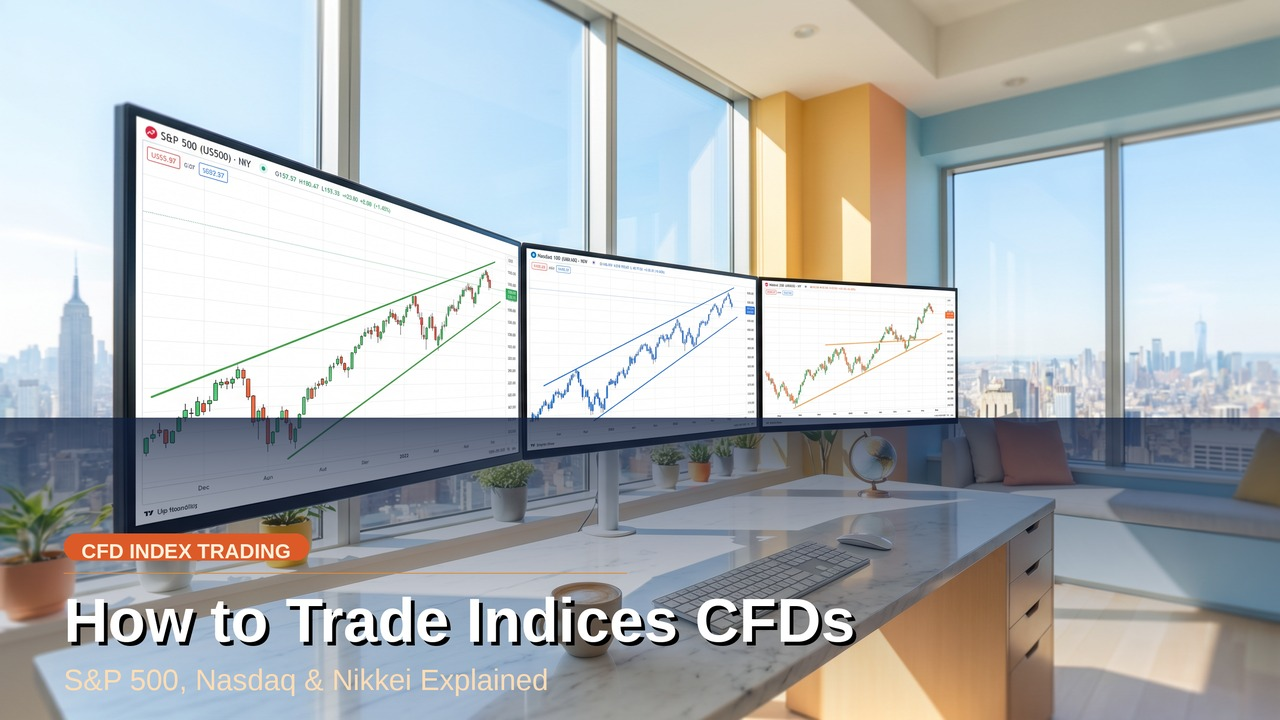
Learn how to trade index CFDs like the S&P 500, Nasdaq, and Nikkei, including insights on leverage, pricing, and MT5 execution for active traders.
Stock indices give you exposure to entire markets in a single trade. Instead of picking one company and hoping it outperforms, you're trading the collective movement of hundreds of stocks at once. That's why index CFDs attract active traders who want broad market exposure without the complexity of stock selection.
This guide covers how index CFD pricing works, the difference between cash and futures contracts, and how to trade the S&P 500, Nasdaq, and Nikkei on MT5 — with practical context for traders based in Southeast Asia and Japan.
A CFD (Contract for Difference) on an index lets you speculate on the price movement of that index without owning any of the underlying stocks. You go long if you expect the index to rise, short if you expect it to fall. Your profit or loss is the difference between your entry price and exit price, multiplied by your position size.
Index CFDs are popular for three reasons:
The cost of trading an index CFD comes from the spread (the gap between the buy and sell price) and, depending on your account type, a commission per lot. Overnight positions also carry a swap charge.
When you browse index CFDs on MT5, you'll often see two versions of the same index. Understanding the difference matters.
Cash indices (also called spot indices) track the real-time price of the underlying index. They have no expiry date, so you can hold them as long as you want. The trade-off is that overnight swap fees apply. Cash indices are the preferred choice for day traders and scalpers who open and close positions within the same session.
Futures indices are based on the futures contract price for that index. They carry a wider spread but no overnight swap. Traders who plan to hold positions for several days or weeks often find futures indices more cost-effective because the swap cost doesn't accumulate.
Choose cash for short-term trades. Choose futures if you're holding overnight for multiple sessions and want to avoid daily swap charges building up.
The S&P 500 tracks 500 large-cap US companies. It's the most widely watched equity benchmark in the world, and its CFD version is one of the most liquid instruments you can trade.
Key characteristics:
For traders in Southeast Asia, the US session opens late at night or in the early hours of the morning. Many traders in Vietnam, Thailand, and Indonesia focus on the pre-market and early US session, where volatility is highest.
The Nasdaq 100 tracks the 100 largest non-financial companies listed on the Nasdaq exchange, heavily weighted toward technology. Think Apple, Microsoft, Nvidia, Meta.
Because tech stocks are growth-sensitive, the Nasdaq tends to move more aggressively than the S&P 500 in response to interest rate expectations and earnings reports. That means wider intraday ranges and more trading opportunities — but also more risk per point of movement.
If you're running an EA on MT5 that targets momentum setups, the Nasdaq is one of the most active instruments available.
The Nikkei 225 is Japan's primary stock index, tracking 225 companies listed on the Tokyo Stock Exchange. It's the natural starting point for traders based in Japan, South Korea, and parts of Southeast Asia who want to trade during the Asian session.
Key characteristics:
For traders in Southeast Asia, the Nikkei session overlaps with local morning hours, making it a practical choice for those who prefer not to trade late at night.
Leverage lets you control a larger position than your deposit alone would allow. At Spec Markets, leverage goes up to 1000:1 depending on the instrument. Index CFDs typically carry lower leverage limits than forex pairs, but the principle is the same.
A simple example: if the S&P 500 is priced at 5,200 points and your broker sets a margin requirement of 1% (100:1 leverage), you need $52 in margin to control a position worth $5,200.
Leverage amplifies both gains and losses. A 1% move against your position at 100:1 leverage wipes the full margin on that trade. This is why position sizing and stop-loss placement are non-negotiable, not optional.
Spec Markets includes a zero cut system — negative balance protection that prevents your account from going below zero. Your funds are also held in segregated accounts at top-tier banks. These are baseline safety features, not substitutes for disciplined risk management.
Ready to trade index CFDs with tight spreads and fast execution? Open a live or demo account at specmarkets.com and access the S&P 500, Nasdaq, Nikkei, and more from one MT5 account.
MT5 is the platform of choice for index CFD trading. Here's the basic workflow:
MT5 also supports Expert Advisors for automated index trading. If you run an algo strategy on the Nikkei or Nasdaq, you can deploy it directly through MT5 on your Spec Markets account.
Index CFD trading carries real risk. A few things to keep front of mind:
What is the minimum deposit to trade index CFDs at Spec Markets?
The minimum deposit is $50. Both the Raw Zero and Pure Spread accounts give you access to index CFDs including the S&P 500, Nasdaq, and Nikkei on MT5.
What is the difference between a cash index and a futures index CFD?
A cash index tracks the real-time spot price of the index with no expiry date but carries overnight swap fees. A futures index is based on the futures contract price, has an expiry date, and typically carries a wider spread but no daily swap charge. Cash indices suit day traders; futures indices can be more cost-effective for multi-day holds.
Can I trade the Nikkei during Asian market hours?
Yes. The Nikkei 225 trades during Tokyo Stock Exchange hours (9:00 AM to 3:30 PM JST), which aligns with morning trading hours across Southeast Asia and Japan. It's one of the most accessible major indices for traders in the region.
How does leverage affect my index CFD trades?
Leverage lets you control a larger notional position with less capital. At Spec Markets, leverage on indices is available up to the platform maximum. Because leverage amplifies both gains and losses, always use a stop-loss and size your positions carefully. CFD trading involves significant risk of loss.
Does Spec Markets offer negative balance protection on index CFDs?
Yes. The zero cut system at Spec Markets prevents your account balance from going below zero, even during fast-moving markets. Client funds are also held in segregated accounts at top-tier banks.
Can I use an Expert Advisor (EA) to trade index CFDs on MT5?
Yes. Spec Markets fully supports EA and algorithmic trading on MT5. You can deploy automated strategies across all available index CFDs, including the S&P 500, Nasdaq, and Nikkei.
Which index CFD is best for traders in Southeast Asia?
There's no single answer — it depends on your schedule and strategy. The Nikkei suits traders who prefer the Asian session. The S&P 500 and Nasdaq offer the highest liquidity but are most active during US hours, which fall late at night for traders in Vietnam, Thailand, Indonesia, and Malaysia.
Index CFDs give you access to some of the world's most traded markets in a single instrument. Whether you're scalping the Nasdaq during the US open, trading the Nikkei during Tokyo hours, or running an EA on the S&P 500, the mechanics are the same: understand the pricing, manage your leverage, and execute with precision.
Learn more and open your account at specmarkets.com.
CFD trading involves significant risk of loss and is not suitable for all traders. Leverage can work against you as well as for you. Ensure you fully understand the risks involved before trading. Your capital is at risk.