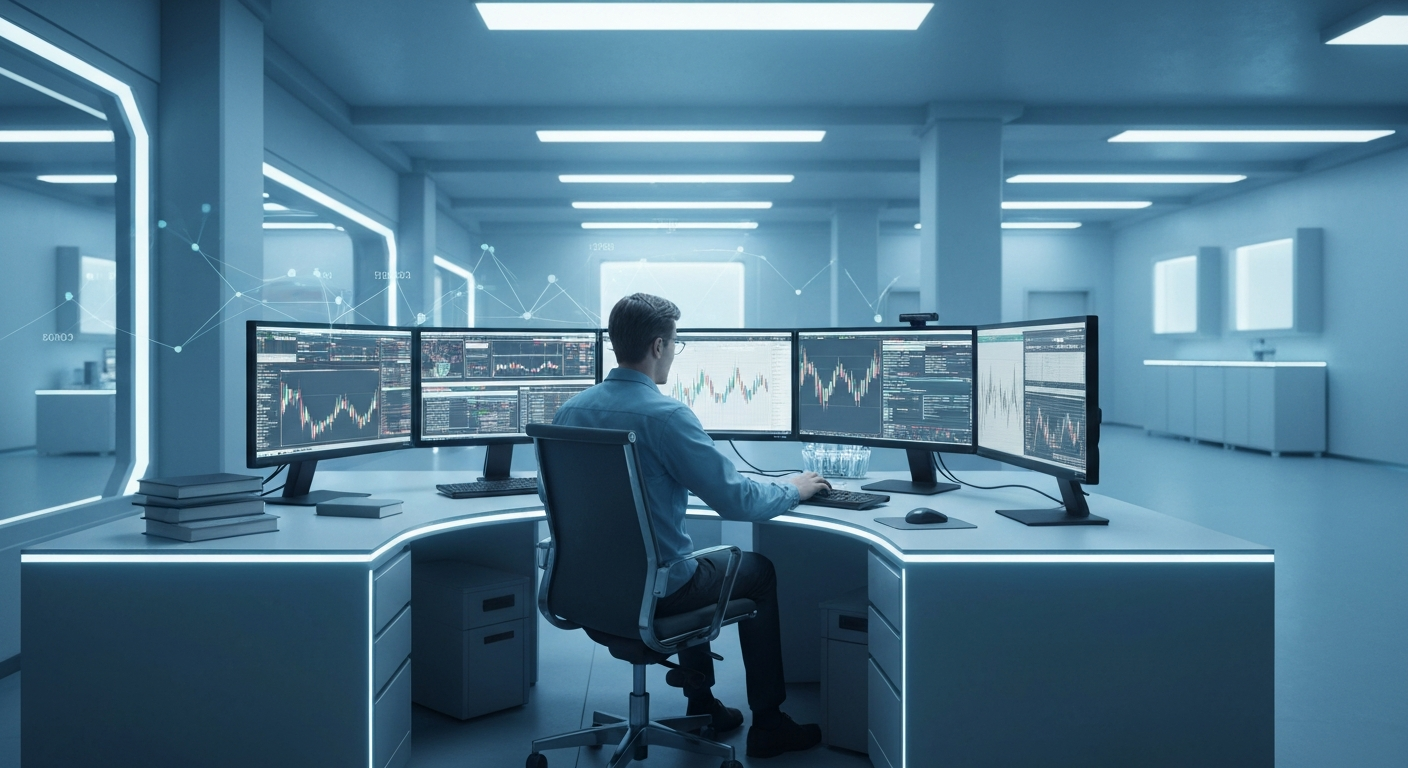
Forex is the largest financial market in the world, with over $7 trillion changing hands daily. That scale creates real opportunity — but it also creates an overwhelming amount of noise. Hundreds of indicators, conflicting signals, and round-the-clock price action make it genuinely hard to identify which strategies hold up over time.
Manual backtesting helps, but it takes hours per strategy. Most retail traders don't have that kind of time.
AI trading strategy analysis changes the equation. Rather than building and testing strategies from scratch, you can evaluate AI-powered bots that have already run historical simulations across specific market conditions. You get structured, data-backed performance metrics without the manual workload — and you still make the final call on every trade.
A standard rule-based system follows fixed logic: if X, then Y. An AI trading strategy goes further. It processes larger datasets, surfaces non-obvious correlations across price, volume, and time, and refines its signal generation as conditions evolve.
For Forex specifically, this matters in two concrete ways.
Currency pairs generate enormous amounts of price data across dozens of timeframes. AI models like GPT-5.2 and DeepSeek Reasoner can work through that data to identify recurring candlestick formations, momentum shifts, and breakout setups that a human analyst might miss — or simply take too long to spot.
The key word is "identify." The strategy surfaces the signal. You decide whether to act on it.
One of the more reliable approaches in Forex analysis is aligning signals across multiple timeframes before entering a position. A breakout on a 15-minute chart carries more weight when the 4-hour and daily charts confirm the same directional bias.
AI strategies built on Multi-Timeframe Confirmation logic automate that alignment check. Instead of manually cross-referencing three or four charts, you get a consolidated view of whether conditions line up — without the legwork.
These are the strategy types most relevant to Forex markets, each serving a distinct analytical purpose.
The Average Directional Index measures trend strength, not direction. A reading above 25 typically signals a strong trend; below 20 suggests a ranging market. AI strategies built on ADX logic use this to filter out low-conviction setups and concentrate signal generation on periods when a clear trend is actually present.
For Forex, this is particularly useful on major pairs like EUR/USD or GBP/USD, where trends can extend across days or weeks.
The MACD tracks the relationship between two exponential moving averages. AI strategies using this logic look for crossovers, divergence from price, and histogram momentum shifts to identify potential entry and exit zones.
MACD-based strategies tend to perform better in trending Forex environments than in choppy, sideways conditions — worth keeping in mind when matching strategy to market regime.
Bollinger Bands measure price volatility relative to a moving average. When price compresses near the bands and then breaks out, it can signal the start of a directional move. AI strategies built on this logic monitor for band squeezes and breakout conditions across multiple pairs simultaneously.
The Bollinger Squeeze variant takes this further, targeting the low-volatility compression phase specifically — before the potential breakout develops.
Engulfing bars, pin bars, doji formations — candlestick patterns have been studied in Forex for decades. AI models can scan for these setups across all active currency pairs in real time, flagging configurations that match historical pattern criteria. That removes the need to manually monitor multiple charts looking for the same thing.
Not every AI strategy suits every trader. Before incorporating any AI-generated signal into your analysis, consider these four factors.
1. Historical simulation performance
Look at cumulative return over the simulation period. A strategy showing +7.8% in historical backtesting tells you something about its behavior under past conditions. It does not guarantee future results. Treat it as a data point, not a promise.
2. Market specificity
A strategy optimized for Commodities may behave differently when applied to Forex. Check whether the bot's historical data was generated specifically in Forex conditions or across mixed markets.
3. Strategy type vs. market regime
Trend-following strategies like ADX Trend Strength and MACD Trend perform differently in trending markets than in ranging ones. Match the strategy type to the conditions you're currently analyzing.
4. AI model transparency
Know which model powers the strategy. GPT-5.2, DeepSeek Reasoner, and MiniMax-M2.1 each have different reasoning architectures. Understanding what drives a strategy helps you assess how it processes signals and where its analytical strengths actually lie.
The AI model powering a strategy isn't just a label — it reflects how that strategy processes market data and generates signals.
GPT-5.2 runs across multiple strategy types on Trader.AI, including Bollinger Band Breakout and MACD Trend. Its strength is pattern synthesis across large datasets.
DeepSeek Reasoner powers strategies like ADX Trend Strength and Trend + Momentum Confirmation. Its reasoning-focused architecture suits multi-condition logic well — strategies where several signals need to align before a setup gets flagged.
MiniMax-M2.1 drives the current top-ranked bot on the leaderboard, Slade-0xBE, which runs Candlestick Pattern Recognition in Commodities with a simulated cumulative return of +31.2% based on historical data. Past performance is not indicative of future results.
When evaluating an AI Forex strategy, the model matters as much as the strategy type. Both shape the quality and consistency of the analysis you're working with.
Trader.AI is not an execution platform. It doesn't place trades for you. What it provides is a structured way to discover, compare, and evaluate AI trading strategies before you decide to act.
The AI Traders page lists bots running across Forex, Crypto, Commodities, and Equities — each with a detailed profile showing the AI model, strategy type, market focus, and cumulative historical return. The leaderboard ranks bots by performance, giving you a quick read on which strategies have the strongest historical simulation results.
For Forex specifically, you can identify which bots are running Forex-focused strategies, review their historical performance metrics, and use that data to inform your own analysis. Every trade remains yours to make.
This sits in a useful middle ground. It's more transparent than a black-box signal service, and more structured than building your own backtests from scratch. Traders who already use TradingView for charting can run Trader.AI alongside it — one for visual analysis, one for AI strategy discovery.
Treating simulated returns as guaranteed outcomes. Historical simulation shows how a strategy behaved under past conditions. Forex markets shift. Use the data to understand a strategy's tendencies, not to predict what comes next.
Ignoring the strategy type. A bot running Multi-Timeframe Confirmation logic in a trending market will behave very differently in a choppy, range-bound environment. Match the strategy to current conditions before drawing conclusions.
Over-relying on a single bot. No single strategy works across every market regime. Reviewing multiple bots across different strategy types gives you a broader picture of where AI analysis is pointing.
Skipping the model review. The AI model behind a strategy affects how it processes signals. Two bots using different models on the same strategy type can produce meaningfully different outputs — that difference is worth understanding.
Confusing analysis with execution. AI trading strategy tools provide intelligence. You provide the judgment. The analysis is automated. The decisions are yours.
What is an AI trading strategy for Forex?
An AI trading strategy for Forex uses machine learning or large language models to analyze price data, identify patterns, and generate signals about potential trade setups. Unlike static rule-based systems, AI strategies can process larger datasets and adapt their signal logic as market conditions evolve. The strategy provides analysis; the trader decides whether to act.
Are AI Forex trading strategies reliable?
AI Forex strategies can provide structured, data-backed analysis, but no strategy holds up in every market condition. Performance metrics on platforms like Trader.AI are based on historical simulations — past performance is not indicative of future results. The value is in using AI analysis as one informed input in your process, not as a guaranteed signal.
What AI models are used in Forex trading strategies?
Trader.AI's strategies are powered by GPT-5.2, DeepSeek Reasoner, and MiniMax-M2.1. Each has a different reasoning architecture, which shapes how it processes market data and generates signals. DeepSeek Reasoner, for example, is well-suited to multi-condition logic strategies like ADX Trend Strength.
How is AI strategy analysis different from copy trading?
Copy trading platforms like eToro replicate the live trades of human signal providers. AI strategy analysis platforms like Trader.AI provide intelligence derived from AI bots running historical simulations. You review the data and make your own trading decisions. There's no human signal provider, and the platform doesn't execute trades on your behalf.
Which AI Forex strategies work best in trending markets?
Trend-following strategies — ADX Trend Strength, MACD Trend, and Multi-Timeframe Confirmation — are generally better suited to trending Forex environments. They're designed to identify and follow directional momentum. In ranging or choppy markets, breakout strategies like Bollinger Band Breakout may be more relevant, though all strategies should be evaluated against current conditions before use.
Can I use AI trading strategy analysis alongside TradingView?
Yes. Trader.AI and TradingView serve different functions. TradingView provides charting and manual technical analysis tools. Trader.AI provides AI-powered strategy discovery and historical simulation data. Many traders use both: TradingView for visual chart analysis, Trader.AI to identify which AI strategies have performed well under similar historical conditions.
Does Trader.AI execute Forex trades automatically?
No. Trader.AI is an analysis and intelligence platform. It does not execute trades on your behalf. You use it to discover and evaluate AI strategies, then make your own trading decisions based on the data. The analysis is automated. The decisions are yours.
AI trading strategy analysis gives Forex traders a faster, more structured way to evaluate approaches that would otherwise take hours to backtest manually. The key is using it correctly — as a data-backed input to your analysis, not a substitute for your own judgment.
Strategies built on ADX Trend Strength, MACD Trend, Bollinger Band Breakout, and Multi-Timeframe Confirmation each have distinct strengths depending on market conditions. Understanding which AI model powers a strategy, and what historical simulation data actually tells you, is what separates informed use from blind reliance.
To start exploring AI Forex strategies with transparent performance data, visit trader.ai and review the current bot roster. The analysis is there. What you do with it is up to you.
All performance metrics referenced in this article are based on historical simulations. Past performance is not indicative of future results. Trading involves risk.