What Are CFD Indices? How to Trade Stock Indices Without Owning Shares
Learn how to trade CFD indices to gain exposure to major stock markets like the S&P 500 and NASDAQ without the need to own individual shares.

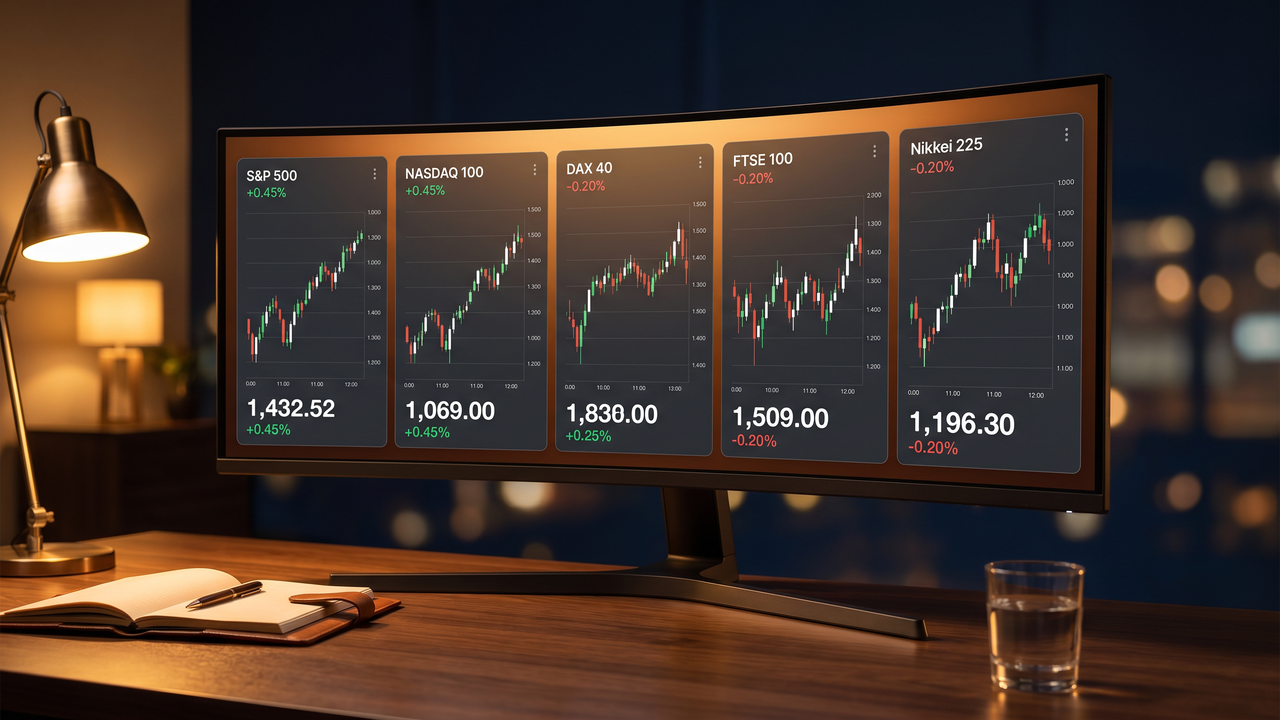
Learn how to trade CFD indices to gain exposure to major stock markets like the S&P 500 and NASDAQ without the need to own individual shares.
Stock indices represent the performance of entire markets or sectors, but buying every stock in an index would require massive capital and complex portfolio management. CFD indices solve this problem by letting you trade the price movements of major stock indices without owning the underlying shares.
This guide explains how CFD indices work, which major indices you can trade, and how to start trading them on MetaTrader 5 with tight spreads and fast execution.
A stock index tracks the performance of a group of stocks, usually representing a specific market, country, or sector. Think of it as a basket containing multiple stocks, with each stock weighted by factors like market capitalization or price.
The S&P 500, for example, tracks 500 large US companies. When Apple, Microsoft, or Amazon stock prices rise, the S&P 500 index value increases. When these stocks fall, the index drops.
Indices serve three main purposes:
Traditional index investing requires buying index funds or ETFs. CFD indices offer a different approach — you trade the index price directly with leverage, going long or short based on your market view.
CFD indices are contracts for difference based on stock index prices. You don't own the underlying stocks or index shares. Instead, you speculate on whether the index will rise or fall.
Here's how it works:
Long position: You buy the index CFD if you expect the index to rise. If the S&P 500 trades at 5,200 and you buy 1 lot, you profit from every point the index moves above 5,200.
Short position: You sell the index CFD if you expect the index to fall. Using the same example, you profit from every point the index drops below 5,200.
Leverage amplifies exposure: With 100:1 leverage, a $1,000 deposit controls $100,000 worth of index exposure. This magnifies both profits and losses.
No expiry dates: Unlike futures contracts, CFD indices don't expire. You can hold positions as long as you want, subject to overnight financing charges.
The key advantage is flexibility. You can trade rising and falling markets with the same ease, using leverage to maximize your trading capital efficiency.
The S&P 500 represents 500 large-cap US companies across all sectors. It's market-cap weighted, meaning larger companies like Apple and Microsoft have more influence on the index price.
Trading characteristics:
What moves the S&P 500: GDP growth, inflation data, interest rate changes, corporate earnings, geopolitical events affecting US markets.
The NASDAQ 100 tracks 100 of the largest non-financial companies on the NASDAQ exchange. It's heavily weighted toward technology stocks, making it more volatile than the S&P 500.
Trading characteristics:
What moves the NASDAQ 100: Tech earnings reports, growth vs. value rotation, interest rate expectations, innovation cycles, regulatory changes affecting tech companies.
The DAX 40 represents Germany's 40 largest companies, including industrial giants like Siemens, BMW, and SAP. It's a performance index that includes dividend reinvestment.
Trading characteristics:
What moves the DAX 40: German manufacturing data, European Central Bank decisions, automotive industry trends, export demand, energy prices.
The FTSE 100 includes the 100 largest UK companies by market cap. It has significant exposure to banking, oil, and mining sectors.
Trading characteristics:
What moves the FTSE 100: Bank of England policy, oil prices, mining commodity prices, UK economic data, political developments.
The Nikkei 225 tracks 225 Japanese companies, weighted by stock price rather than market cap. It includes major exporters like Toyota, Sony, and Nintendo.
Trading characteristics:
What moves the Nikkei 225: Bank of Japan policy, yen exchange rates, export data, Chinese economic growth, global risk sentiment.
Diversification without complexity: One index CFD gives you exposure to hundreds of stocks. Instead of researching individual companies, you trade broad market movements.
Lower capital requirements: You can start trading major indices with just $50. Traditional index investing through funds often requires higher minimums and doesn't offer leverage.
Go long or short equally: Profit from rising and falling markets. Traditional stock investing makes it difficult to profit from market declines.
No dividend complications: You don't receive dividends from underlying stocks, but you also avoid the tax complications and reinvestment decisions that come with dividend-paying investments.
24/5 trading opportunities: While individual stock markets have specific hours, you can trade index CFDs during extended hours, capturing overnight moves and global events.
Ready to explore index trading opportunities? Start Trading with spreads from 0.0 pips and execution in 0.028 seconds.
Precise position sizing: CFD indices let you trade exact position sizes based on your risk tolerance, rather than being limited to full shares or minimum fund investments.
MetaTrader 5 provides professional tools for index CFD trading. Here's how to start:
1. Choose your account type:
2. Access index CFDs: Open MT5 and navigate to the Market Watch. Look for indices like US500, NAS100, GER40, UK100, and JPN225.
3. Analyze the market: Use MT5's built-in technical analysis tools. Apply moving averages, RSI, MACD, and support/resistance levels to identify trading opportunities.
4. Place your trade:
5. Monitor and manage: Track your positions in the Terminal window. Adjust stop losses as the trade moves in your favor, or close positions when your target is reached.
Expert Advisor support: MT5 supports automated trading through Expert Advisors. You can code or purchase EAs that trade index CFDs based on technical indicators or market conditions.
Trend following: Identify the primary trend using moving averages or trendlines. Buy index CFDs during uptrends, sell during downtrends. The 50-day and 200-day moving average crossover is a popular signal for longer-term trends.
Range trading: When indices trade sideways between support and resistance levels, buy near support and sell near resistance. This works well during low-volatility periods.
News-based trading: Economic announcements, earnings seasons, and central bank meetings create volatility. Trade the immediate reaction or position for longer-term moves based on fundamental changes.
Sector rotation: Different indices perform better during different economic cycles. Technology-heavy NASDAQ might outperform during growth phases, while broader indices like S&P 500 might be more stable during uncertainty.
Correlation trading: Indices often move together but with different intensities. If the S&P 500 breaks to new highs but the NASDAQ lags, you might trade the NASDAQ expecting it to catch up.
Gap trading: Indices sometimes gap up or down at market open due to overnight news. You can trade gap fills (expecting the gap to close) or gap extensions (expecting the move to continue).
Position sizing: Never risk more than 1-2% of your account on a single trade. If you have a $5,000 account, don't risk more than $50-100 per trade.
Stop losses: Always use stop losses to limit potential losses. Place them beyond recent support/resistance levels or based on volatility measures like Average True Range.
Leverage awareness: High leverage amplifies both gains and losses. Start with lower leverage until you understand how index CFDs behave in different market conditions.
Correlation risk: Don't trade multiple correlated indices simultaneously. The S&P 500, NASDAQ, and Russell 2000 often move together, so trading all three multiplies your US market exposure.
Time-based risk: Indices can be more volatile during market opens, closes, and major news releases. Adjust your position sizes during these high-volatility periods.
Overnight financing: Holding positions overnight incurs swap charges. Factor these costs into longer-term trades, especially for large positions.
Spreads: The difference between bid and ask prices. Tighter spreads reduce your trading costs, especially for frequent trading strategies.
Commission: Raw Zero accounts charge $3.50 per lot per side but offer spreads from 0.0 pips. Pure Spread accounts have no commission but wider spreads starting from 1.0 pips.
Swap rates: Overnight financing charges for positions held beyond the trading day. Long positions on rising indices might earn positive swaps, while short positions typically pay negative swaps.
Slippage: During high volatility, your order might fill at a different price than requested. This is more common during news releases or market opens.
Market hours: While you can hold positions 24/5, active trading should focus on times when the underlying stock markets are open for better liquidity and tighter spreads.
Margin requirements: You need sufficient margin to open and maintain positions. If your account equity falls below margin requirements, positions may be automatically closed.
The zero cut system protects you from negative account balances, but proper risk management prevents you from reaching that point.
What is the minimum deposit to start trading CFD indices?
You can start trading CFD indices with a minimum deposit of $50 on both Raw Zero and Pure Spread accounts. This gives you access to major indices like S&P 500, NASDAQ, DAX, and FTSE with leverage up to 1000:1.
Can I trade CFD indices 24 hours a day?
CFD indices are available for trading 24/5, but liquidity and spreads are best during the underlying market's trading hours. The S&P 500 CFD, for example, has tightest spreads during US market hours (9:30 AM - 4:00 PM EST).
What's the difference between trading individual stocks and index CFDs?
Index CFDs give you exposure to entire markets rather than single companies. This provides instant diversification and reduces company-specific risk. You're trading broad market movements rather than individual stock performance.
How much leverage can I use for index CFD trading?
Spec Markets offers leverage up to 1000:1 on index CFDs. However, high leverage increases both profit potential and loss risk. Most experienced traders use moderate leverage (10:1 to 100:1) combined with proper risk management.
Do I pay dividends when trading index CFDs?
You don't receive actual dividends from underlying stocks, but dividend adjustments may be applied to your positions when index components pay dividends. These adjustments reflect the economic impact of dividends on the index price.
What happens if I hold an index CFD position overnight?
Overnight positions incur swap charges (financing costs). The rate depends on the index, position direction (long or short), and current interest rates. These costs are automatically calculated and applied to your account.
Which index CFD is best for beginners?
The S&P 500 (US500) is often recommended for beginners due to its high liquidity, predictable trading hours, and extensive market analysis available. It's less volatile than tech-focused indices like NASDAQ but still offers good trading opportunities.
CFD indices provide efficient access to global stock markets without the complexity of buying individual shares or index funds. You can trade major indices like S&P 500, NASDAQ, DAX, and FTSE with leverage, tight spreads, and professional execution on MT5.
The key to successful index CFD trading is understanding what drives each index, using appropriate risk management, and choosing the right account type for your trading style. Whether you prefer the tech exposure of NASDAQ or the broad diversification of S&P 500, index CFDs offer flexible ways to trade your market views.
Start trading index CFDs today with institutional-grade execution and community features that pure execution brokers don't offer. Learn more at specmarkets.com.
Risk Warning: CFD trading involves significant risk of loss due to leverage. You should consider whether you understand how CFDs work and whether you can afford to take the high risk of losing your money. Past performance is not indicative of future results.