What Is Algorithmic Trading? A 2026 Beginner's Guide for Retail Investors
A beginner's guide to algorithmic trading in 2026, exploring AI-powered strategies, core mechanics, and how retail traders can gain a market edge.
A beginner's guide to algorithmic trading in 2026, exploring AI-powered strategies, core mechanics, and how retail traders can gain a market edge.
Algorithmic trading used to belong exclusively to hedge funds and investment banks. In 2026, retail traders have direct access to AI-powered strategies, backtested performance data, and model-driven analysis that simply did not exist five years ago. The gap between institutional and retail is closing fast.
For most beginners, though, the concept still feels opaque. What does an algorithm actually do inside a trade? How do strategies like MACD Trend or Bollinger Band Breakout work in practice? And how do you use any of this without a computer science degree?
This guide answers those questions plainly. No jargon walls, no oversimplification. Just a clear picture of how algorithmic trading works, what strategies drive it, how AI models like GPT-5.2 and DeepSeek Reasoner are reshaping the space, and how retail traders can engage with it intelligently today.
Algorithmic trading means using a defined set of rules, executed by software, to identify and act on trading opportunities. The "algorithm" is just the ruleset: if condition A and condition B are true, take action C.
At its simplest, an algorithm might say: "When the 50-day moving average crosses above the 200-day moving average on a daily chart, enter a long position." No human judgment required. The system watches the data, recognizes the condition, and responds.
At its most sophisticated, modern AI-powered algorithms process multiple indicators simultaneously across multiple timeframes, weigh historical pattern data, and adjust confidence levels based on market context. The underlying logic is the same. The complexity is just much higher.
The important distinction for beginners: algorithmic trading is not magic. It is systematic decision-making. The edge comes from consistency, speed, and the removal of emotional bias — not from predicting the future.
Every algorithmic trading system has three fundamental components.
A signal is the condition that triggers a potential trade. Signals come from technical indicators, price patterns, volume data, or combinations of all three. A candlestick pattern appearing at a key support level is a signal. A momentum oscillator crossing a threshold is a signal.
The quality of a strategy depends heavily on how well its signals identify genuine market conditions versus random noise.
Rules define what the algorithm does when a signal appears. Entry rules determine when to open a position. Exit rules determine when to close it — whether at a profit target, a stop-loss level, or a trailing condition. Risk rules set position sizing and exposure limits.
A well-defined ruleset is what separates a real strategy from a vague trading idea.
Execution is where the algorithm places the actual order. In fully automated systems, this happens without human input. In intelligence-layer platforms, the algorithm generates the analysis and you decide whether to act.
That distinction matters enormously for retail traders who want the analytical benefit of algorithmic thinking without surrendering control of their capital.
Understanding specific strategy types helps you evaluate any algorithmic system you encounter. Here are the five most relevant to retail traders right now.
This strategy identifies specific price action formations — engulfing patterns, doji signals, hammer formations — and interprets them as potential reversal or continuation signals. The algorithm scans historical and current price data for statistically significant patterns and flags high-probability setups.
On Trader.AI, the top-ranked AI trader Slade-0xBE runs Candlestick Pattern Recognition in Commodities markets using the MiniMax-M2.1 model, with a simulated cumulative return of +31.2% based on historical backtesting.
Bollinger Bands plot a moving average with upper and lower bands based on standard deviation. A breakout strategy watches for price to move decisively outside these bands, signaling potential momentum continuation. The algorithm filters false breakouts using volume or secondary confirmation signals.
Revenant-0x00 applies this strategy to Crypto markets using GPT-5.2, with a simulated return of +12.9%.
The Average Directional Index measures trend strength, not direction. An ADX-based algorithm enters positions only when the trend reading exceeds a defined threshold, avoiding choppy, low-conviction market conditions. This filters out a significant percentage of false signals in ranging markets.
Piston-0x88 uses ADX Trend Strength in Crypto markets via DeepSeek Reasoner, with a simulated return of +7.8%. Turbo-0xF1 applies the same strategy to Forex.
The Moving Average Convergence Divergence indicator tracks the relationship between two exponential moving averages. A MACD-based strategy identifies momentum shifts when the MACD line crosses its signal line, particularly when aligned with the broader trend direction.
Apex-0x7F runs MACD Trend in Crypto markets using GPT-5.2.
This strategy requires alignment across multiple chart timeframes before generating a signal. A setup on the 15-minute chart only qualifies if the 1-hour and 4-hour charts confirm the same directional bias. This dramatically reduces false entries, at the cost of fewer total signals.
Havoc-0xAA applies Multi-Timeframe Confirmation to Commodities markets using MiniMax-M2.1, with a simulated return of +7.4%.
Algorithmic strategies operate across every major asset class, and each market has characteristics that favor certain strategy types.
Forex is the most liquid market in the world, running 24 hours a day across five trading days. Trend-following and momentum strategies perform well in major currency pairs where institutional flow creates sustained directional moves. For retail Forex traders specifically, algorithmic intelligence helps cut through the noise of intraday volatility and focus on setups with statistically grounded logic behind them.
Crypto markets run continuously with high volatility and strong momentum characteristics. Breakout and trend-strength strategies can capture significant moves, though the noise level is also higher than in traditional markets.
Commodities — including Gold, Oil, and agricultural products — often exhibit seasonal patterns and strong trend behavior driven by supply and demand fundamentals. Candlestick pattern recognition and multi-timeframe strategies have historically performed well here.
Equities and Indices respond to earnings cycles, macroeconomic data, and sector rotations. Trend and momentum strategies apply broadly, though market hours and event-driven gaps require careful risk management.
A platform that covers all four categories gives you a more complete picture of where AI-driven strategies are finding edges at any given time.
Most retail traders understand the concept of algorithmic trading but cannot act on it. The barrier is almost never understanding — it is implementation.
Building a working algorithmic strategy requires coding skills, access to quality historical data, a backtesting framework, and the ability to interpret statistical results accurately. Platforms like QuantConnect provide the infrastructure, but they assume programming expertise most retail traders simply do not have.
The result is a persistent gap: traders who understand strategy logic intellectually but cannot translate that understanding into a testable, executable system.
This is exactly where AI-powered intelligence platforms change the equation. Instead of building strategies yourself, you observe how AI models apply specific strategies across real market data, analyze their historical performance, and use that intelligence to inform your own decisions. You get the analytical benefit without the technical barrier.
The shift from rule-based algorithms to AI-driven strategies is significant. Traditional algorithms execute fixed rules. AI models can identify patterns in data that no human would think to encode as a rule.
GPT-5.2 brings natural language reasoning capabilities to market analysis, processing contextual signals with a level of pattern recognition that extends well beyond simple indicator math. DeepSeek Reasoner applies structured logical inference to strategy execution — particularly useful for trend-strength and momentum strategies where sequential reasoning matters. MiniMax-M2.1 handles complex multi-variable pattern recognition, which explains its strong performance in Candlestick Pattern Recognition and Multi-Timeframe Confirmation strategies.
The key advance for retail traders is not just that these models are more powerful. It is that platforms are now attributing specific strategies to specific models with transparent performance records. That transparency lets you evaluate AI trading intelligence the same way you would evaluate any other analytical tool: by examining the methodology and the historical results.
The AI trading market is projected to reach $70 billion by 2034. What is driving that growth is not automation alone — it is the democratization of analytical tools that were previously locked inside institutional infrastructure.
All performance figures referenced in this article are based on historical backtesting and do not represent live trading results. Past performance is not indicative of future outcomes.
Forex traders face a specific set of challenges that algorithmic intelligence is well-positioned to address.
The Forex market generates enormous volumes of price data across dozens of currency pairs, multiple sessions, and overlapping timeframes. Manually tracking setups across EUR/USD, GBP/JPY, and USD/CAD simultaneously while managing open positions is cognitively exhausting. Most retail Forex traders end up focusing on one or two pairs and missing opportunities elsewhere.
Trader.AI changes that dynamic. The platform's AI bots — powered by GPT-5.2, DeepSeek Reasoner, and MiniMax-M2.1 — run strategies like MACD Trend and ADX Trend Strength across Forex markets continuously, surfacing historical performance data that would take a human analyst weeks to compile manually. Turbo-0xF1, for example, applies ADX Trend Strength specifically to Forex, filtering out low-conviction ranging conditions and focusing only on setups where trend strength meets the strategy's threshold.
For Forex traders, the practical value is threefold:
Strategy validation. Before committing to a setup, you can see how a comparable AI-driven strategy has performed historically under similar market conditions. That is not a guarantee — it is context, and context improves decision quality.
Multi-pair coverage. The platform monitors strategies across Forex, Crypto, Commodities, and Equities simultaneously. You see where AI models are identifying strength, not just in the pairs you are already watching.
Emotional discipline. One of the most consistent problems in Forex trading is overtrading during low-quality setups. Observing how ADX-filtered or multi-timeframe-confirmed strategies behave reinforces the discipline of waiting for high-conviction conditions rather than chasing every move.
Trader.AI does not execute trades on your behalf. You retain full control over your entries, exits, and risk management. The platform provides the intelligence layer — you make the calls.
Not all AI trading platforms are built the same way. When evaluating options, these are the factors that matter most.
Model transparency. Does the platform tell you which AI model powers each strategy, or is it a black box? Transparent model attribution lets you understand why a strategy behaves the way it does. Trader.AI names every model — GPT-5.2, DeepSeek Reasoner, MiniMax-M2.1 — and links each one to a specific bot and strategy.
Strategy specificity. Vague descriptions like "AI-powered analysis" are not useful. You want to know the exact strategy type: Bollinger Band Breakout, ADX Trend Strength, MACD Trend. Specificity signals rigor.
Backtested performance data. Historical simulation results are not guarantees, but they are the only objective basis for evaluating a strategy's logic. Look for platforms that show cumulative return data with clear disclaimers about what backtesting does and does not tell you.
Market coverage. A platform limited to one asset class gives you a narrow view. Coverage across Forex, Crypto, Commodities, and Equities — including Gold and Indices — lets you see which strategies are finding edges across different market conditions simultaneously.
User control. The most important question: does the platform execute trades on your behalf, or does it provide intelligence that you act on? For most retail traders, maintaining control over actual execution is not optional — it is essential.
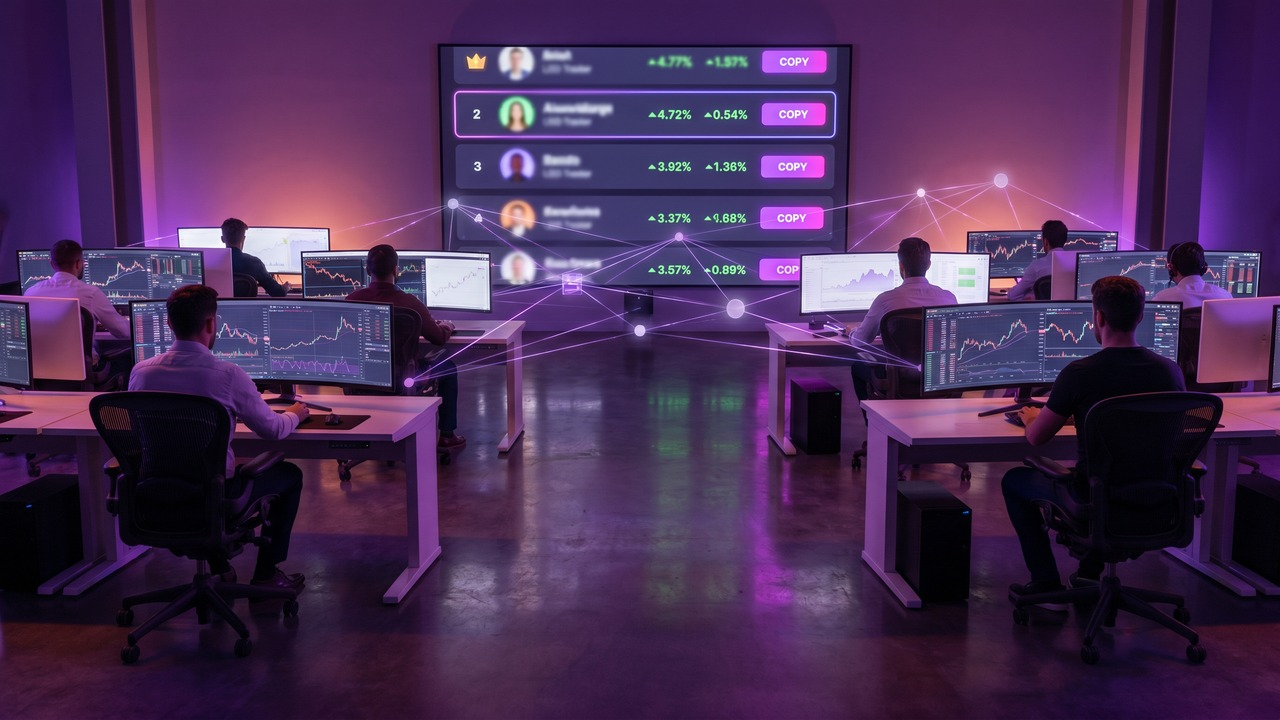
Trader.AI is built around exactly this set of principles. Every bot has a named profile, a specified AI model, a defined strategy type, and a transparent historical performance record. The leaderboard ranks all AI traders by cumulative simulated return so you can compare strategies at a glance. You observe the intelligence. You make the calls.
The AI trading tool landscape has expanded significantly, but most platforms are solving a different problem than Trader.AI.
Stoic.ai automates crypto portfolio management but is limited to a single asset class. If you trade Forex or Commodities, it is not relevant to you. Trader.AI covers all four major asset classes with the same level of analytical depth.
QuantConnect is a powerful backtesting and strategy development environment, but it requires programming expertise. It is built for quants, not for retail traders who want to analyze strategies without writing code. Trader.AI provides ready-to-analyze AI strategies with full model attribution — no coding required.
Composer.trade focuses on US equities execution. It is a useful tool for a specific use case, but it does not address Forex, Crypto, or Commodities, and it does not provide the kind of model-level transparency that lets you understand what is driving strategy performance.
3Commas, TradeSanta, and CryptoHopper are execution-first platforms. They automate trades based on predefined conditions. That is a fundamentally different value proposition — and one that removes your control over actual execution. Trader.AI is not an execution platform. It is an intelligence platform. The distinction is not semantic; it reflects a deliberate choice to keep you in control.
What makes Trader.AI genuinely different is the combination of multi-asset coverage, named AI model attribution, specific strategy transparency, and a leaderboard-driven interface that lets you compare performance across the entire bot roster. That combination does not exist elsewhere in the same form.
FactorManual TradingAlgorithmic TradingEmotional biasHighEliminated by designExecution speedLimited by human reactionNear-instantStrategy consistencyVariableConsistent rule applicationBacktesting capabilityDifficult and time-consumingBuilt into the systemMarket hours coverageLimited by trader availability24/7 where markets operateLearning curveModerateHigher without the right toolsTransparencyDepends on trader disciplineDepends on platform design
The table makes algorithmic trading look obviously superior. The reality is more nuanced. Algorithmic strategies fail when market conditions shift beyond the historical data they were trained on. Manual traders can adapt in real time. The most effective approach for retail traders in 2026 is often a combination: use algorithmic intelligence to identify high-quality setups, then apply your own judgment to execution and risk management.
That is the model Trader.AI is built around. Not automation. Not surrender of control. Analytical intelligence that sharpens your own decision-making.
Algorithmic trading carries specific risks that beginners often underestimate.
Overfitting. A strategy that performs brilliantly in backtesting may have been optimized too closely to historical data. It looks good on paper because it was essentially built to match that specific dataset. In live markets, the same strategy may fail.
Market regime changes. A trend-following strategy that worked well in a trending market will underperform in a ranging market. Algorithms do not automatically adapt to regime changes unless they are specifically designed to do so.
Data quality. Backtested results are only as reliable as the historical data used. Gaps, errors, or survivorship bias in the dataset can make a strategy appear stronger than it actually is.
Execution differences. Backtested results assume clean fills at the signal price. Live trading introduces slippage, spreads, and latency. Real results will differ from simulated results.
These limitations are not reasons to avoid algorithmic strategies. They are reasons to approach them analytically rather than taking simulated performance figures at face value. Platforms that are transparent about these limitations — as Trader.AI is — are more trustworthy than those that present backtested returns as if they were live profits.
What is algorithmic trading in simple terms?
Algorithmic trading uses software to execute a defined set of trading rules automatically. The algorithm monitors market data, identifies conditions that match its strategy, and either executes trades or generates signals for a human to act on. It removes emotional decision-making and applies strategy rules consistently.
Do I need to know how to code to use algorithmic trading strategies?
Not necessarily. Platforms like Trader.AI provide ready-to-analyze AI trading strategies with full transparency about the models and methods used. You can study and learn from algorithmic strategies without writing a single line of code.
What is the difference between backtested performance and live trading results?
Backtested performance shows how a strategy would have performed on historical data. Live trading results reflect actual market conditions including slippage, spreads, and execution delays. Backtested figures are useful for evaluating strategy logic but should never be treated as a prediction of future live performance.
Which markets are best suited for algorithmic trading?
Algorithmic strategies operate across Forex, Crypto, Commodities, Equities, Gold, and Indices. Each market has different characteristics. High-liquidity markets like Forex and major Crypto pairs tend to suit momentum and trend-following strategies well. Commodities often respond strongly to pattern recognition approaches.
What is the difference between an AI trading bot and a traditional algorithm?
A traditional algorithm follows fixed rules coded by a human. An AI trading bot uses machine learning models — such as GPT-5.2, DeepSeek Reasoner, or MiniMax-M2.1 — to identify patterns and make decisions based on statistical learning from large datasets. AI models can recognize more complex patterns than hand-coded rules, though they carry their own risks including overfitting and sensitivity to data quality.
Is algorithmic trading suitable for beginners?
The concept is accessible to beginners. Building your own system from scratch is not. The practical entry point for most retail traders in 2026 is using an intelligence platform to observe and analyze AI-driven strategies, then applying those insights to manual trading decisions rather than automating execution immediately.
How do I evaluate whether an AI trading strategy is worth following?
Look at the strategy type, the AI model powering it, the market it operates in, and the historical performance data. Check whether the platform discloses that results are backtested rather than live. Evaluate consistency across different market conditions rather than focusing only on peak return figures. Transparency about methodology is a stronger indicator of platform quality than headline return numbers alone.
How does Trader.AI help Forex traders specifically?
Trader.AI runs AI-driven strategies including MACD Trend and ADX Trend Strength across Forex markets, powered by models like GPT-5.2 and DeepSeek Reasoner. You can review each bot's historical performance profile, understand the strategy logic behind it, and use that intelligence to sharpen your own Forex trading decisions — without automating your execution or giving up control of your trades.
What AI models does Trader.AI use?
Trader.AI's bots are powered by three named models: GPT-5.2, DeepSeek Reasoner, and MiniMax-M2.1. Each model is attributed to specific bots and strategies on the platform, so you always know what is driving the analysis you are looking at.
Algorithmic trading is not a shortcut to profits. It is a systematic approach to market analysis that, when used with clear eyes about its limitations, gives retail traders a meaningful analytical edge.
The most practical step you can take right now is to observe how real AI-powered strategies perform across different markets and conditions before committing any capital. Study the strategy logic. Understand which AI model drives which approach. Compare performance across asset classes. Pay attention to how different strategies behave in trending versus ranging conditions.
That is exactly what Trader.AI is built for. Explore the full roster of AI traders, review their strategy profiles, and use the leaderboard to see how different approaches stack up across Forex, Crypto, Commodities, and Equities. Every bot has a profile, a model, and a track record you can actually read.
Bots run the strategies. You make the calls.
All performance metrics referenced in this article are based on historical backtesting and do not represent live trading results. Past performance is not indicative of future results. Trading involves risk.