#what-is-leverage-in-forex-trading
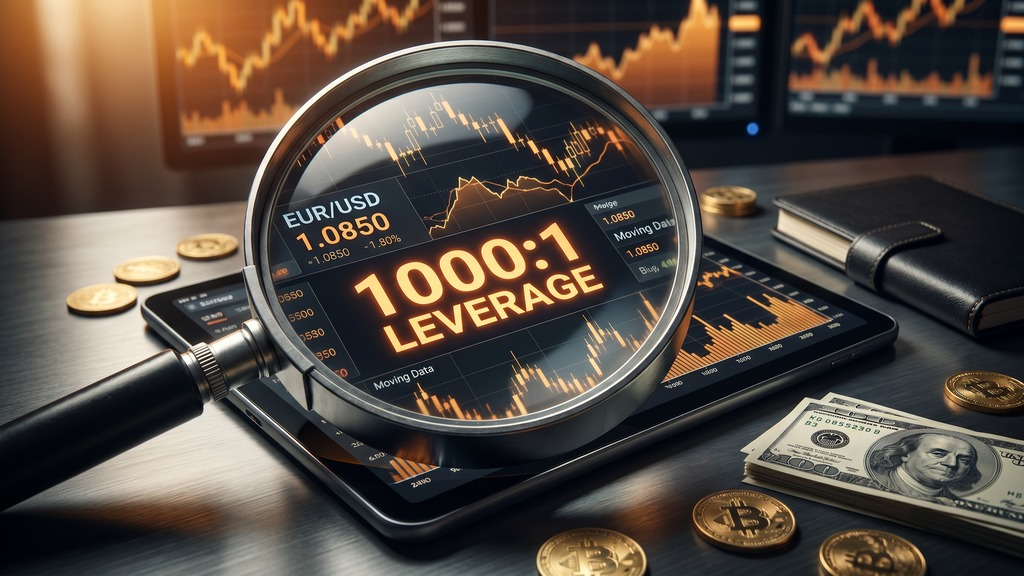
Leverage in forex trading lets you control larger positions with smaller capital. Instead of needing $100,000 to trade one standard lot of EUR/USD, leverage allows you to open that same position with just $100 — or even less.
Think of leverage as borrowed capital from your broker. You put down a small deposit (margin), and your broker provides the rest. This amplifies both your potential profits and losses, making leverage a powerful but double-edged tool that every trader must understand completely.
Leverage ratios express how much capital your broker provides relative to your margin. Common ratios include:
The higher the ratio, the less margin you need to open positions. With 1000:1 leverage, you can control positions 1,000 times larger than your actual investment.
Your margin requirement decreases as leverage increases:
| Leverage Ratio | Margin Required | Position Size with $1,000 |
|---|---|---|
| 50:1 | 2.00% | $50,000 |
| 100:1 | 1.00% | $100,000 |
| 500:1 | 0.20% | $500,000 |
| 1000:1 | 0.10% | $1,000,000 |
At Spec Markets, traders access leverage up to 1000:1 on both Raw Zero and Pure Spread accounts, requiring just 0.10% margin for major forex pairs.
With 1000:1 leverage and a $500 account balance, you can open positions worth up to $500,000. Here's how it breaks down:
EUR/USD Example:
This means you can trade 5 standard lots of EUR/USD while using only $500 of your account as margin.
Leverage amplifies every pip movement. With a 1 standard lot EUR/USD position:
Your profits scale with position size, but so do your losses. A 50-pip adverse move on 10 lots costs $500 — your entire account balance in this example.
Your account shows three key figures:
Formula: Free Margin = Balance - Used Margin
Brokers protect themselves (and you) with margin requirements:
At Spec Markets, the zero cut system ensures you never lose more than your account balance, providing negative balance protection even at 1000:1 leverage.
Major pairs (EUR/USD, GBP/USD, USD/JPY) typically offer the highest leverage — up to 1000:1 at Spec Markets. These pairs have deep liquidity and lower volatility compared to exotic currencies.
Stock indices and commodities usually offer lower leverage ratios due to higher volatility:
Crypto CFDs carry the lowest leverage due to extreme volatility:
Never risk more than 1-2% of your account per trade, regardless of available leverage. With a $1,000 account:
Here's how to apply proper position sizing with 1000:1 leverage:
This approach lets you use high leverage while maintaining strict risk control.
Try a Free Demo to practice position sizing with 1000:1 leverage before risking real capital.
High leverage maximizes your trading capital efficiency. Instead of tying up large amounts in margin, you can:
1000:1 leverage makes forex accessible with smaller account sizes. You can start meaningful trading with just $50 at Spec Markets, compared to the thousands required for unleveraged trading.
High leverage enables various trading styles:
The same mechanism that amplifies profits magnifies losses. A 1% adverse move on a fully leveraged position can wipe out your account. Always use stop losses and proper position sizing.
Brokers may increase margin requirements during high volatility periods. Major news events or market stress can temporarily reduce available leverage, potentially triggering margin calls on existing positions.
High leverage can create emotional trading decisions. The potential for large profits and losses may lead to:
Larger accounts can handle higher leverage more safely:
Your experience level should guide leverage decisions:
Adjust leverage based on market volatility:
Both Spec Markets account types offer identical leverage terms:
Raw Zero Account:
Pure Spread Account:
Spec Markets provides multiple protection layers:
Use only a fraction of available leverage for steady, sustainable growth:
Higher leverage usage for experienced traders:
Adjust leverage based on market conditions and opportunities:
Using maximum available leverage on every trade leads to account destruction. Even profitable strategies fail when overleveraged due to inevitable losing streaks.
Opening multiple highly correlated positions (like EUR/USD and GBP/USD) with high leverage creates concentrated risk that can trigger margin calls.
High leverage without stop losses is gambling, not trading. Always define your maximum acceptable loss before entering positions.
Increasing leverage after losses or reducing it after wins often leads to poor timing and missed opportunities.
Leverage is a powerful tool that can accelerate your trading results when used correctly. 1000:1 leverage provides maximum capital efficiency and flexibility, but requires disciplined risk management and proper position sizing.
The key is understanding that leverage amplifies both profits and losses equally. Your success depends not on the leverage ratio available, but on how wisely you use it within a comprehensive trading plan.
Start with conservative leverage levels as you develop your skills, then gradually increase usage as your experience and account size grow. Remember that consistent profitability with moderate leverage beats spectacular failures with maximum leverage every time.
Open a Live Account at Spec Markets to access 1000:1 leverage with spreads from 0.0 pips, or start with a free demo account to practice your leverage strategies risk-free.
Risk Warning: Trading leveraged products such as CFDs involves substantial risk of loss and may not be suitable for all investors. Leverage can work against you as well as for you, and losses may exceed your initial deposit. Ensure you fully understand the risks involved and seek independent advice if necessary.