What Is Leverage in Forex Trading? Understanding 1000:1 Leverage in 2026
Learn how leverage works in forex trading, the implications of 1000:1 ratios, and how to manage risks like margin and position sizing effectively.
Learn how leverage works in forex trading, the implications of 1000:1 ratios, and how to manage risks like margin and position sizing effectively.
Leverage lets you control a position much larger than what you actually deposit. In forex, your broker extends credit so that $100 can open a trade worth $10,000, $50,000, or more — depending on the ratio available.
It works as a multiplier. Your capital stays the same, but your market exposure scales up. That amplification cuts both ways: gains grow faster, and so do losses.
For active retail traders, leverage is a big part of what makes forex accessible in the first place. Without it, a 0.5% move on a standard lot would barely register. With leverage, that same move becomes meaningful relative to your account size.
Say you fund an account with $500 and your broker offers 100:1 leverage. You can open a position worth $50,000.
If EUR/USD moves 1% in your favor, that $50,000 position gains $500 — a 100% return on your deposit.
If EUR/USD moves 1% against you, you lose $500 — your entire deposit.
That is the core mechanic. The percentage move in the market is small. The percentage impact on your capital is large. This is why understanding leverage before you trade is not optional — it underpins every risk decision you will ever make.
Different brokers and regulators set different maximums. Here is how the most common ratios translate to margin requirements and position exposure:
| Leverage Ratio | Margin Required | Position Size for $100 Deposit |
|---|---|---|
| 10:1 | 10% | $1,000 |
| 50:1 | 2% | $5,000 |
| 100:1 | 1% | $10,000 |
| 500:1 | 0.2% | $50,000 |
| 1000:1 | 0.1% | $100,000 |
Regulators in the EU and UK cap retail leverage at 30:1 for major forex pairs. Brokers operating in other jurisdictions — including much of Southeast Asia — can legally offer significantly higher ratios, up to 1000:1.
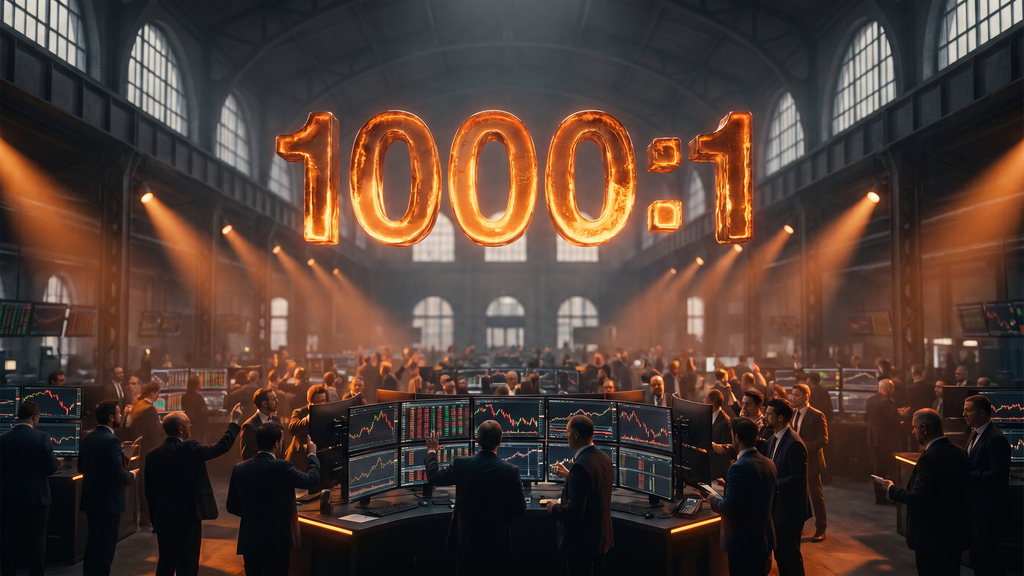
At 1000:1, every $1 in your account controls $1,000 in market exposure. A $50 deposit can open a $50,000 position.
This ratio is available to retail traders at brokers like Spec Markets, where both the Raw Zero and Pure Spread accounts offer leverage up to 1000:1 with a $50 minimum deposit.
For scalpers and day traders who move in and out of positions quickly, high leverage makes it possible to generate meaningful returns from small intraday price moves. A scalper targeting 5–10 pips on EUR/USD does not need a large account — they need precise execution and disciplined position sizing.
That said, 1000:1 is not something you deploy carelessly. It is a tool. Paired with tight stop-losses and controlled sizing, it gives active traders real capital efficiency. Without a risk framework, it can wipe an account in minutes.
Leverage and margin are two sides of the same concept. Leverage tells you the multiplier. Margin tells you the deposit required to hold the position.
At 1000:1, the margin requirement is 0.1%. On a $10,000 position, you need $10 in margin. On a $100,000 standard lot, you need $100.
Key margin terms every trader should know:
Keeping an eye on your margin level matters just as much as watching price action. A solid trade idea means nothing if poor margin management forces you out before the move plays out.
High leverage does not cause losses on its own — poor position sizing and missing stop-losses do. But leverage amplifies every mistake you make.
Three specific risks worth understanding:
1. Rapid account depletion
A 0.1% adverse move at 1000:1 wipes 100% of the margin on that position. Without a stop-loss, a small move against you can close your trade and drain your account faster than you can react.
2. Overtrading
Low margin requirements make it easy to stack too many positions at once. Each one carries risk. Open enough of them and a correlated move across markets can hit every trade simultaneously.
3. Emotional decision-making
When losses scale up fast, traders often abandon their plan — moving stop-losses, adding to losing positions, or cutting winners short. Leverage does not create bad habits, but it makes their consequences immediate.
The answer is not to avoid leverage. It is to size positions relative to your account, not relative to the maximum exposure your leverage allows.
Experienced traders treat leverage as a precision instrument, not a volume knob. Here is a practical framework:
Risk a fixed percentage per trade. Most professional traders risk 1–2% of their account on any single trade. At 1000:1 leverage, you can still open meaningful positions while keeping individual trade risk contained.
Always use stop-losses. A stop-loss is not optional when trading with leverage. It defines your maximum loss before you enter the trade — not after the market has already moved against you.
Calculate position size before you trade. Use a position size calculator — Spec Markets has one at the calculator page — to find the right lot size based on your account balance, stop-loss distance, and risk percentage.
Be cautious holding leveraged positions overnight. Swap rates apply to overnight positions, and gap risk increases when markets reopen. If you are scalping or day trading, close out before the session ends.
Start smaller than you think you need to. New traders often assume maximum leverage is the fastest path to meaningful returns. In practice, lower leverage with disciplined sizing gives you more control and cleaner risk management.
In fast-moving markets, prices can gap sharply. A central bank announcement or a geopolitical shock can move a currency pair hundreds of pips in seconds. If you are on the wrong side with high leverage and no protection, your account balance can go negative.
Negative balance protection — sometimes called a zero cut system — prevents that. If your equity hits zero, the broker absorbs any further loss. Your balance cannot go below zero.
At Spec Markets, this is built into both account types as the zero cut system. It is a meaningful safety net for traders using high leverage: your risk is capped at what you deposit, not what the market could theoretically take from you.
This is also one reason regulated status matters. Regulated brokers are required to maintain the infrastructure and capital reserves to honor negative balance protection. Unregulated brokers make no such guarantee.
Not every trader needs 1000:1. The right leverage depends on how you actually trade.
Scalpers and high-frequency day traders benefit most from high leverage. They target small pip moves, hold positions for seconds to minutes, and rely on volume and precision. Low margin requirements let them run multiple positions efficiently without tying up large amounts of capital.
Swing traders typically work with moderate leverage — somewhere between 50:1 and 200:1. Their trades run for hours to days, so they need room for price to move without margin pressure forcing early exits.
Long-term position traders often use the lowest leverage, sometimes 10:1 or less. They hold trades for weeks or months and need to survive significant drawdowns without hitting stop-out levels.
Not sure where you fall? Start with a demo account. Test your strategy, watch how your equity moves, and find the leverage level that lets you execute your plan without second-guessing every tick.
CFD and forex trading involves significant risk of loss. Leverage amplifies both gains and losses. You may lose more than your initial deposit if negative balance protection is not in place. Only trade with capital you can afford to lose.
What is leverage in forex trading?
Leverage lets you control a position larger than your deposited capital. A 100:1 ratio means $1 of your money controls $100 in market exposure. It amplifies both potential gains and potential losses.
What does 1000:1 leverage mean?
At 1000:1, every $1 in your account controls $1,000 in market value. A $50 deposit can open a $50,000 position, with a margin requirement of just 0.1%. It is available to retail traders at certain brokers — including Spec Markets, where both account types offer up to 1000:1.
Is high leverage dangerous for beginners?
High leverage accelerates how quickly losses can accumulate. Beginners trading without stop-losses or a clear position sizing approach face serious risk. The leverage ratio itself is not the problem — trading without a risk management framework is. Start on a demo account with lower leverage until your strategy is consistently profitable.
What is the difference between leverage and margin?
Leverage is the multiplier applied to your position. Margin is the deposit required to open and hold it. They move inversely: higher leverage means lower margin requirements. At 1000:1, the margin requirement is 0.1% of the position size.
What happens if my account balance hits zero with high leverage?
At a broker with negative balance protection — like Spec Markets' zero cut system — your account cannot go below zero. The broker absorbs any loss beyond your deposited balance. Without this protection, you could owe the broker money beyond your deposit, which is why trading with a regulated broker that offers this feature matters.
How much leverage should I use as a day trader?
Most professional day traders size positions to risk 1–2% of their account per trade, regardless of the maximum leverage available. The ratio your broker offers sets the ceiling — your risk management framework determines what you actually use.
Does leverage affect spreads or commissions?
No. Leverage has no impact on trading costs. Spreads and commissions are determined by your account type. On a Raw Zero account at Spec Markets, spreads start from 0.0 pips with a $3.50 commission per lot per side. On a Pure Spread account, spreads start from 1.0 pips with no commission. Both accounts offer the same leverage up to 1000:1.
Leverage is the most powerful variable in retail forex trading — and the most misunderstood. At its core, the concept is straightforward: you control more than you deposit. The same math that makes it attractive is the math that makes it dangerous when used without discipline.
Understanding margin, position sizing, and stop-loss placement is what turns leverage from a liability into a tool. Whether you are scalping with 1000:1 or swing trading with 50:1, the principle holds: control your risk per trade, and let the leverage work for you rather than against you.
Ready to put it into practice? Spec Markets offers institutional-grade execution, spreads from 0.0 pips, and negative balance protection built into both account types. Explore your account options at Spec Markets and start trading with a $50 minimum deposit.
Trading CFDs and forex carries a high level of risk due to leverage. Past performance is not indicative of future results. Ensure you fully understand the risks involved before trading.